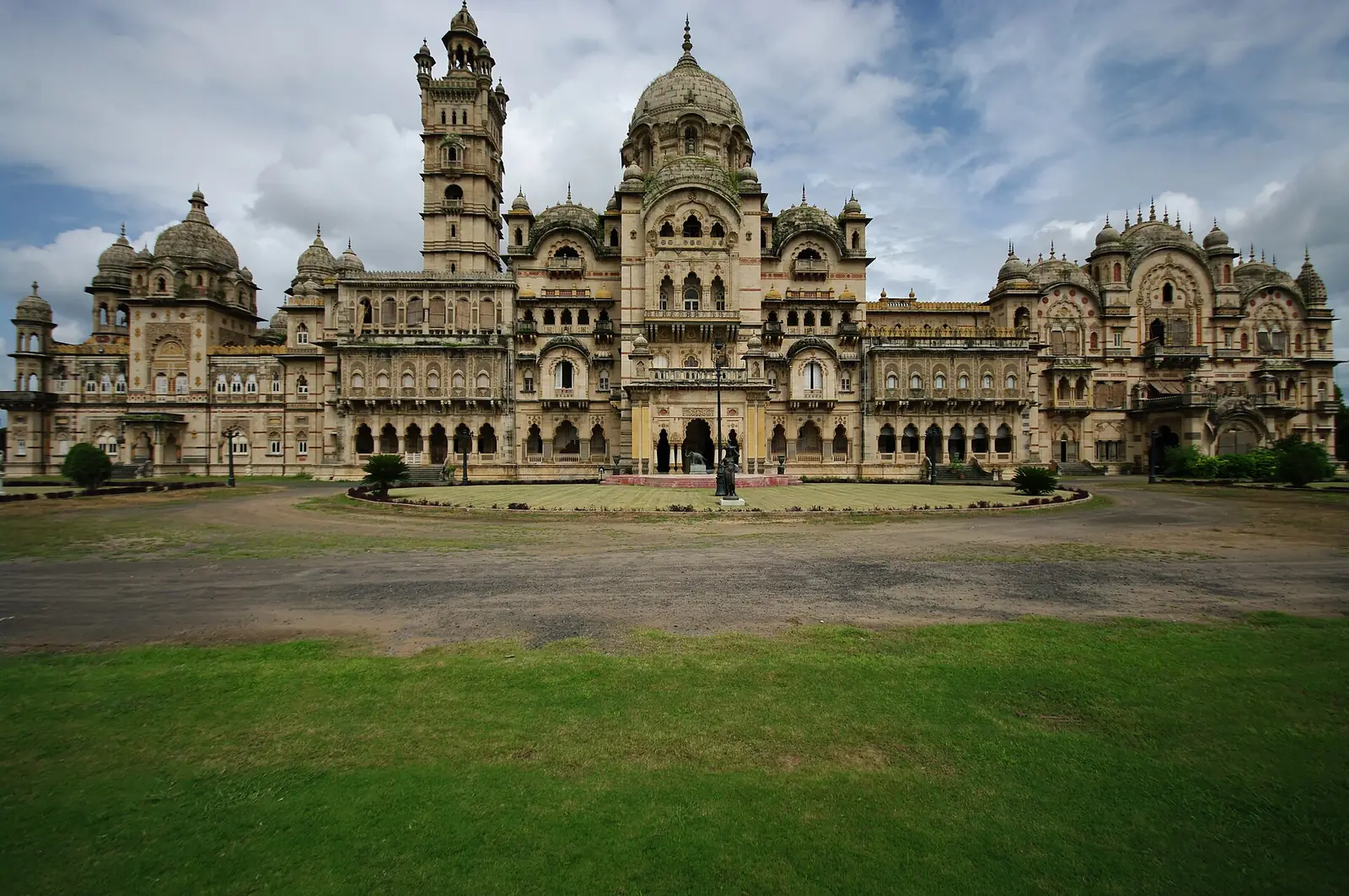
01Sayajirao’s palace
Sayajirao was a farmer’s boy of the Gaekwad clan from Kavlana near Malegaon, chosen and adopted in 1875 after the British deposed Malharrao. Educated for the throne, he ruled Baroda for sixty-four years. The palace was begun to designs by Major Charles Mant, who died before it was done; Robert Fellowes Chisholm finished it in 1890. It mixes Rajput, Maratha, Mughal and European forms, with domes, a clock tower, mosaics and Venetian work, set in a great park. Raja Ravi Varma painted for the Maharaja here, and many of his canvases hang in the Maharaja Fatehsinh Museum in the grounds.
02A reforming court
From this palace Sayajirao made primary education free and compulsory across Baroda state in 1906, ahead of British India, built a network of village libraries, and opened schools and hostels to every caste. In 1913 he gave Bhimrao Ambedkar the scholarship that took him to Columbia University. He backed Indian industry, Sanskrit learning and Indian music, and the Baroda court gave a home to musicians such as Ustad Faiyaz Khan. Sri Aurobindo served in his administration and taught at Baroda College from 1893 to 1906.
The life of this place
- 1875Sayajirao III is adopted to the Baroda throne.
- 1890The palace is completed.
- 1906Primary education is made free and compulsory in Baroda state.
- 1913Sayajirao funds Ambedkar’s studies at Columbia.
Parts of the palace and the Fatehsinh Museum are open to visitors on paid entry; the family lives in the rest.