01Warmadewa kings and Airlangga
Bali’s written history opens with a stone pillar at Belanjong in Sanur, dated Shaka 835, 914 CE, in which Sri Kesari Warmadewa records a victory. His line, the Warmadewa, ruled for two centuries and issued copper-plate charters in Old Balinese and Old Javanese. Around 989 King Udayana married the Javanese princess Mahendradatta, and their son Airlangga became the great king of East Java. From then Bali and Java shared a court language, the kakawin poems retelling the Ramayana and Mahabharata, and the Shaiva and Buddhist priesthoods that served the kings.
02Majapahit comes to Bali
In 1343 the armies of Majapahit under the minister Gajah Mada conquered Bali, and a Javanese court was set up at Samprangan and later at Gelgel. When Majapahit itself declined in Java and Islam spread through the north coast ports in the late 15th and early 16th centuries, priests, nobles, artists and scholars crossed the narrow strait to Bali, bringing palm-leaf manuscripts with them. Bali became the keeper of the Hindu-Javanese world. Its royal houses still trace their descent to Majapahit, and the lontar libraries of Bali preserve Old Javanese texts that are lost in Java itself.
03Dang Hyang Nirartha
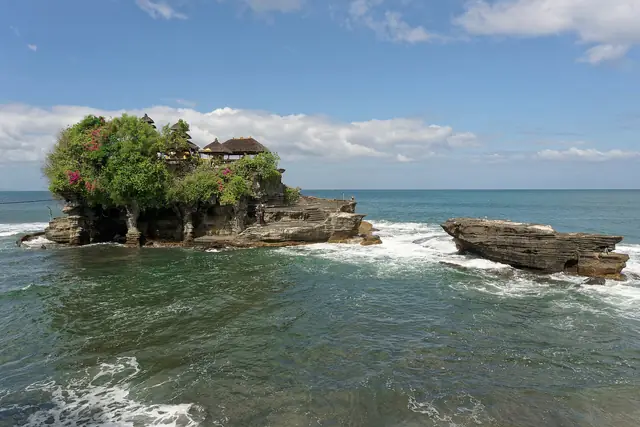
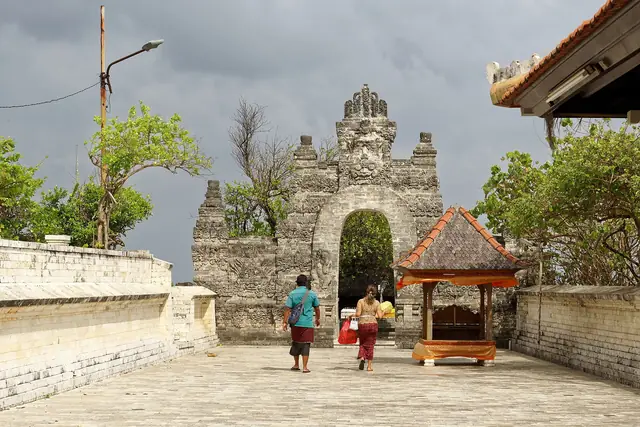
The priest who shaped Balinese worship most came from Java in the reign of Dalem Waturenggong of Gelgel, in the early 16th century. Dang Hyang Nirartha, also called Pedanda Shakti Wawu Rauh, travelled the island’s coast founding temples. Tanah Lot on its sea rock and Uluwatu on its cliff above the Indian Ocean are both linked to him; tradition holds he attained moksha at Uluwatu. He introduced the padmasana, the empty stone throne for Sanghyang Widhi, the supreme Lord, that stands in the north-east corner of nearly every Balinese temple. The Brahmana pedanda families of Bali descend from him.
04Besakih on the mountain
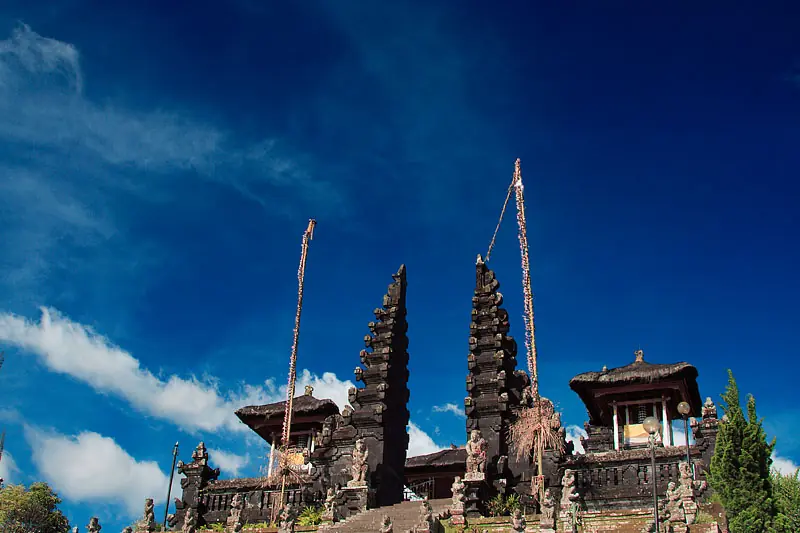
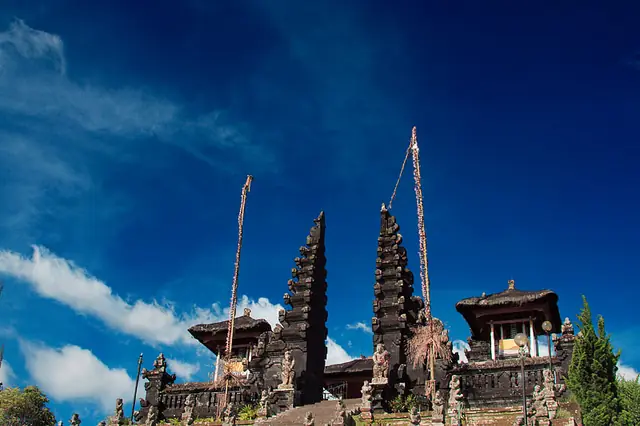
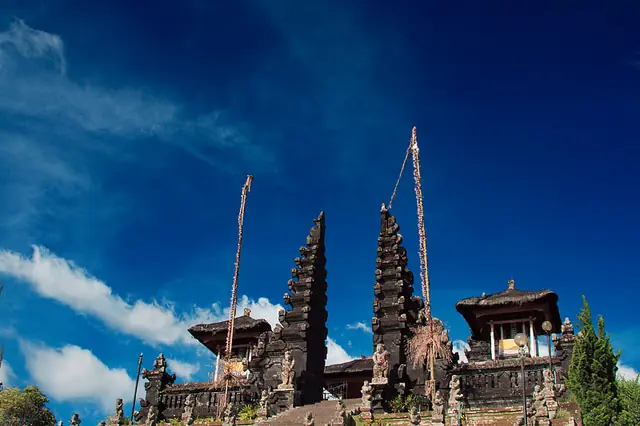
Pura Besakih climbs the south-west slope of Gunung Agung, Bali’s highest and holiest mountain, in terraces of more than twenty temples. It is the mother temple of the island, where every clan and kingdom keeps a shrine. In 1963 the great Eka Dasa Rudra purification, held once a century, was under way when Agung erupted; more than a thousand people died across the island, but the lava flows passed Besakih by, and many Balinese took that as a sign. The full rite was held again in 1979. Kuningan and the temple’s own odalan festivals bring lakhs up the mountain.
05Galungan, Nyepi and the calendar
Bali keeps two calendars. On the 210-day pawukon cycle comes Galungan, when the ancestors return and dharma’s victory over adharma is celebrated; tall bamboo penjor poles arch over every street, hung with rice and coconut leaf. Ten days later, at Kuningan, they leave. On the lunar Saka calendar comes Nyepi, the new year. The night before, villages parade ogoh-ogoh, huge figures of demons, and burn them. Then for twenty-four hours from dawn the whole island keeps silence: no fire, no light, no work, no travel. Even Denpasar airport shuts.
06Subak and Tri Hita Karana
Bali’s rice terraces are watered by subak, farmers’ societies that share water from the crater lakes through tunnels and channels. Each subak has its water temple, and the whole system answers to the temples of the lakes, Pura Ulun Danu Batur and Pura Ulun Danu Beratan. The Balinese name the principle behind it Tri Hita Karana: harmony with God, with other people, and with nature. UNESCO inscribed the subak landscape as a World Heritage Site in 2012. A farmer here does not open a sluice without an offering at the shrine above it.
07Puputan and the Dutch
The Dutch took the north of Bali in the mid-19th century but the southern kingdoms held out. On 20 September 1906, when a Dutch force marched on Badung, the raja, his family, priests and courtiers walked out of the palace at Denpasar dressed in white, with their kris drawn, into the rifles. Hundreds died. Balinese call such a last stand puputan, the ending. Klungkung, the senior kingdom, met the same end in April 1908. A monument stands in Puputan Square in Denpasar today, and the day is kept every year.
08Agama Hindu Dharma
Independent Indonesia recognised only religions with one God and a scripture, and Balinese priests and scholars set out to state their faith in those terms. In 1959 they founded the Parisada Hindu Dharma at Denpasar, and in 1962 Hinduism was recognised by the Ministry of Religion. The Parisada gave the faith its present name, Agama Hindu Dharma, set Sanghyang Widhi Wasa as the one supreme God, and spread the Trisandhya, a prayer said three times a day that opens with the Gayatri Mantra. Schools teach it, and across Bali it is broadcast at dawn, noon and dusk.
More than four in five of Bali’s people are Hindu, and the 2010 census counted more than four million Hindus across Indonesia, the largest Hindu population in South-East Asia. Every village keeps its three temples, every house its family shrine, and the Ramayana is still danced as kecak at Uluwatu at sunset.