
Sanskrit is found first, and only, in India. It belongs to the Indo-European family together with Persian, Greek, Latin and most European languages, which makes them cousins, not parents and child. Where that family began is still debated; no Sanskrit has ever been found in Europe.
The proof
- William Jones, Third Anniversary Discourse to the Asiatick Society, Calcutta (1786): "The Sanscrit language, whatever be its antiquity, is of a wonderful structure; more perfect than the Greek, more copious than the Latin, and more exquisitely refined than either."
- The oldest written Indic words anywhere are the names Mitra, Varuna, Indra and the Nasatyas in a Mitanni treaty from Syria, about 1380 BCE, not in Europe.
- The Nadistuti hymn of the Rigveda (10.75) names the rivers of Bharat from the Ganga to the Sindhu.
01The claim
In its crude form the claim says Sanskrit is really a European tongue, carried into India by fair-skinned invaders, so that the language of the Vedas is foreign to the land. It is the linguistic half of the old invasion story, and like that story it came with a racial ranking attached: the Europeans as the original Aryans, the Indians as their diluted descendants.
02Where it came from
When William Jones told the Asiatick Society in Calcutta in 1786 that Sanskrit, Greek and Latin must spring from some common source, he praised Sanskrit above both. Within a century the discovery had been turned into a search for the Aryan homeland and the Aryan race. Penka placed it in Scandinavia, Kossinna in Germany, and by the 1930s the swastika, taken from Indian tradition, flew over a regime that claimed Aryan descent for Germans alone. In India the textbook version survived independence for decades.
03What linguistics actually says
Related languages share an ancestor; one does not come from another. Sanskrit pitar, Greek pater, Latin pater and English father are cousins descended from a reconstructed mother tongue, Proto-Indo-European, which nobody wrote down. Sanskrit did not come from Latin or Greek, and they did not come from it. Where the mother tongue was spoken is the open question. Most linguists favour the steppes north of the Black and Caspian Seas, and the genetic finding of steppe-related ancestry entering South Asia in the second millennium BCE is read by them as support. A minority, including Indian scholars such as Shrikant Talageri, argue for an origin in India. Neither side places Sanskrit in Europe.
04What the record shows
Every Sanskrit text we have, from the Rigveda on, was composed and handed down in Bharat. The rivers of the Rigveda are the rivers of the Punjab and Haryana, the Sarasvati praised above all. Panini wrote the grammar that fixed Classical Sanskrit at Shalatula near Attock, on the Indus. The only early trace of Indic speech outside the subcontinent points west to Syria, where Mitanni princes swore by Indian gods about 1380 BCE. Whatever the distant prehistory of the family, Sanskrit as a language was shaped, written and kept alive in India.
05What to read
Read Jones’s Third Discourse of 1786; it is short. Edwin Bryant’s The Quest for the Origins of Vedic Culture (2001) sets out every side of the homeland debate without taking one. David Anthony’s The Horse, the Wheel, and Language (2007) makes the steppe case, and Shrikant Talageri’s The Rigveda: A Historical Analysis (2000) makes the case for India. For the Mitanni evidence, see the Boğazköy treaty on this site.
Read on
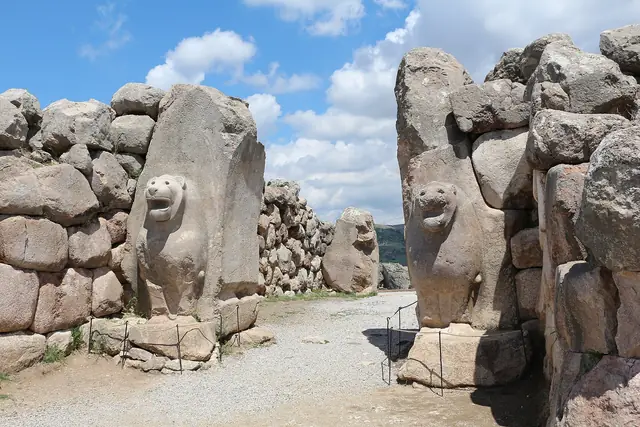
Boğazköy treaty naming Mitra, Varuna, Indra and the Nasatyas
A treaty between the Hittite king Suppiluliuma I and Shattiwaza, prince of Mitanni in north Syria, sworn before the gods of both kingdoms. Among the Mitanni gods stand four names any Vedic priest would know.
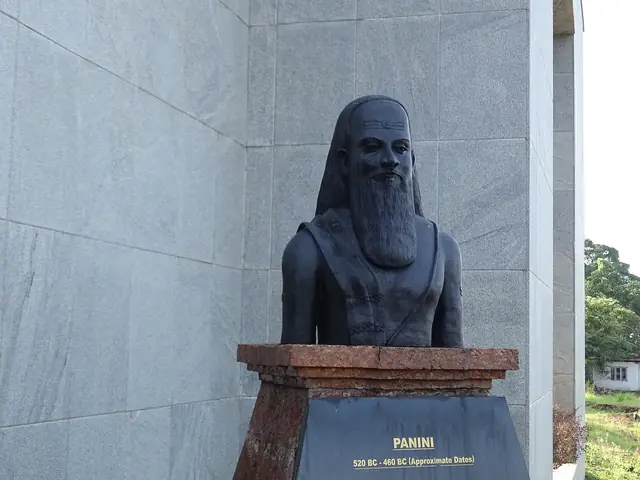
Panini
Panini of Shalatura, in the north-west near the Sindhu, described all of Sanskrit in about 3,959 sutras. His Ashtadhyayi is still the rulebook of the language and is studied by linguists and computer scientists for its method.
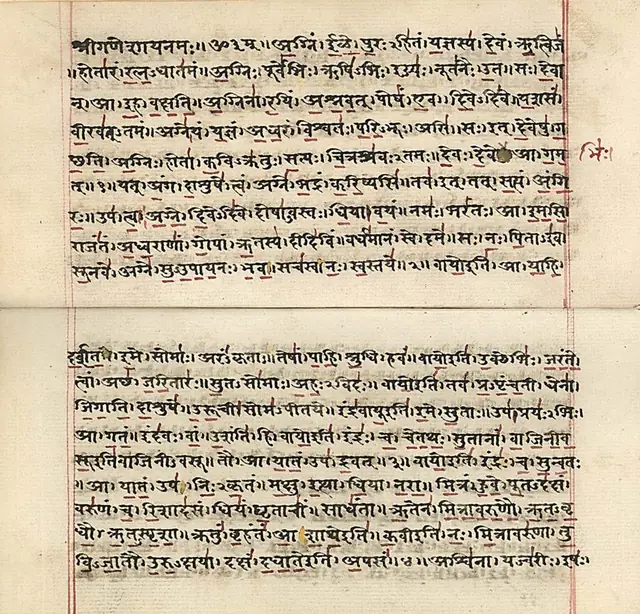
Vedic Rishis and the Itihasa
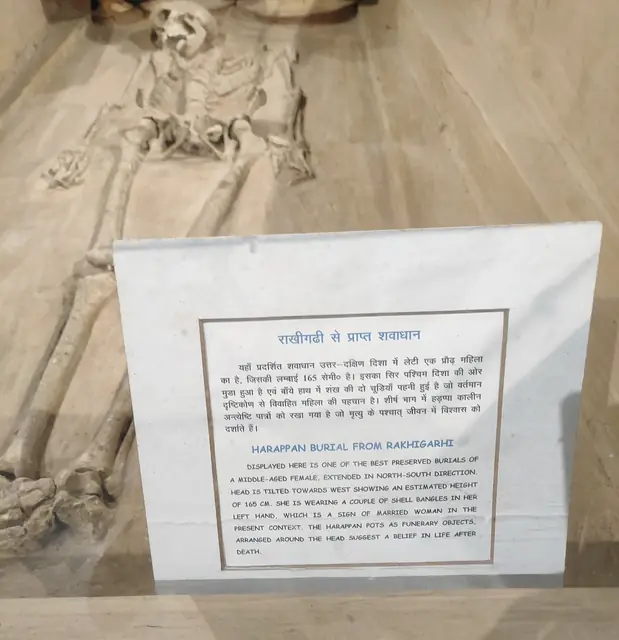
The Rakhigarhi genome
The first ancient genome recovered from a person of the Sindhu–Sarasvati cities, a woman buried at Rakhigarhi more than 4,000 years ago.