01Twenty-seven temples
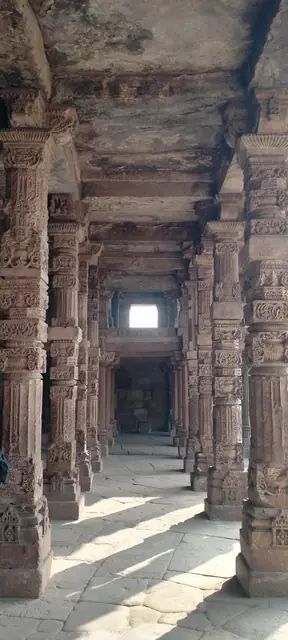
After Prithviraj Chauhan fell at Tarain in 1192, Delhi was taken, and Aibak began the Quwwat-ul-Islam mosque on the plinth of the chief temple of the citadel. The Persian inscription over its east gate says it was built from the materials of 27 temples, each of which had cost twenty lakh deliwals. You can see them still: the colonnades are made of temple pillars stacked two high, carved with bells on chains, kirtimukhas, lotus medallions and here and there a defaced figure. The great screen of arches added in 1199 is carved with Quranic verses by Hindu masons whose lotus and creeper still wind between the letters.
02The minar and the iron pillar
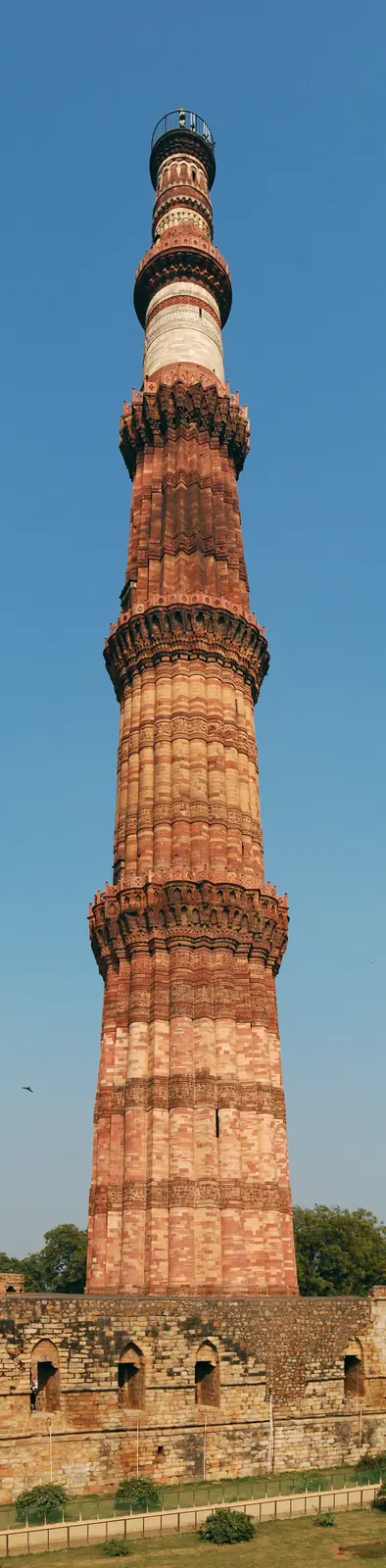
Aibak began the minar around 1199 and finished only the first storey; Iltutmish added three more. Lightning struck it in 1368 and Firoz Shah Tughlaq rebuilt the top in marble, bringing it to about 72.5 metres. In the mosque courtyard stands the iron pillar, over seven metres tall, whose Sanskrit inscription in Gupta script praises a king named Chandra, generally taken to be Chandragupta II, and calls it a dhvaja of Bhagwan Vishnu. It was brought here from elsewhere, and after sixteen centuries in the open it has hardly rusted. Alauddin Khalji added the domed Alai Darwaza in 1311. UNESCO listed the complex in 1993.
The life of this place
- 1192–93Aibak begins the Quwwat-ul-Islam mosque from the materials of 27 temples.
- c. 1199The arched screen is added and the Qutb Minar begun.
- 1311Alauddin Khalji builds the Alai Darwaza.
- 1368After a lightning strike Firoz Shah Tughlaq rebuilds the upper storeys.
- 1993Inscribed as a UNESCO World Heritage Site.
In Mehrauli, south Delhi, next to the Qutub Minar metro station; an ASI ticketed site, open daily.