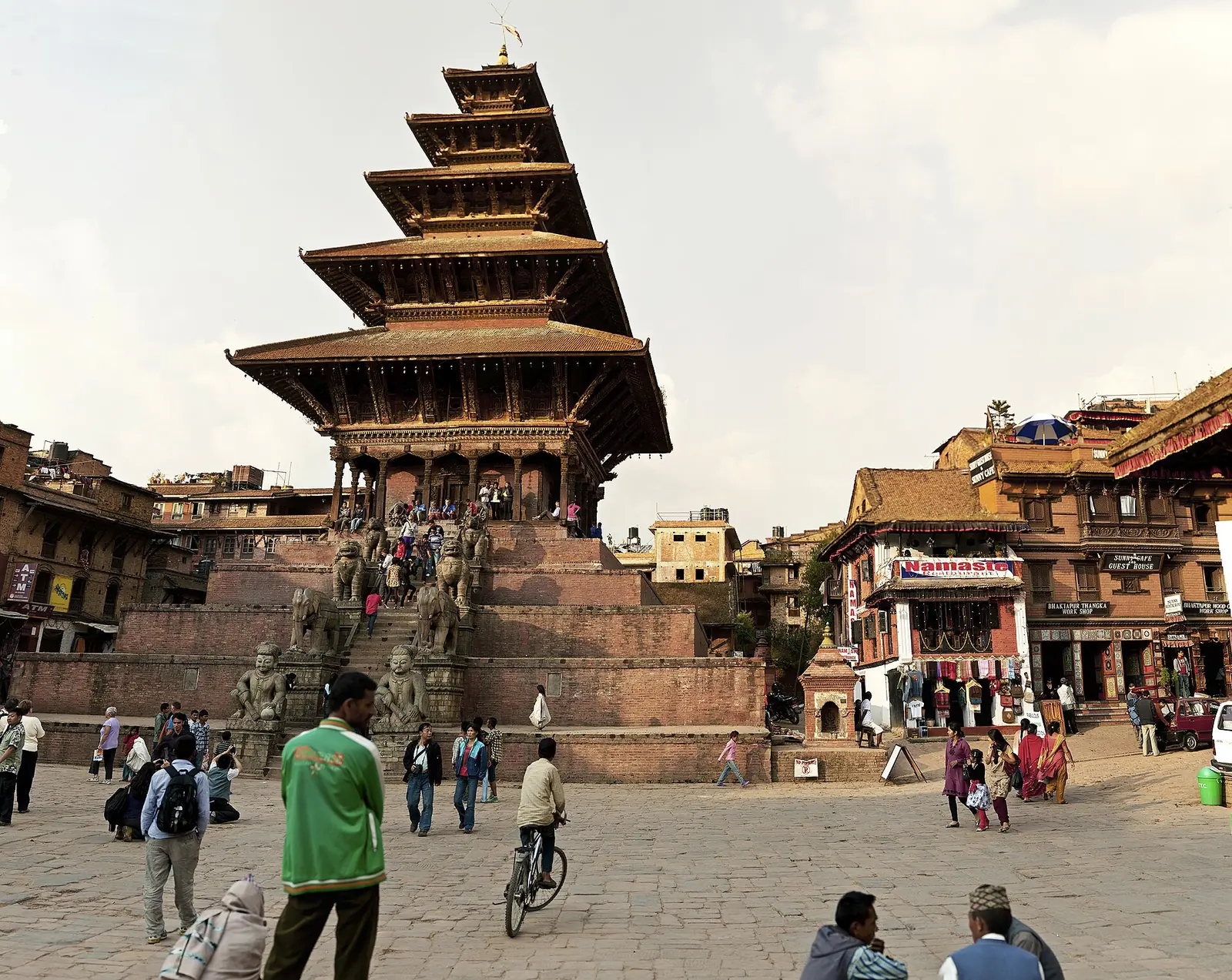
01Guardians on the stairs
Nyatapola means five storeys in Newari. The temple sits on a stepped plinth of five terraces, and on each side of the stairway stands a pair of stone guardians. At the bottom are the wrestlers Jaya Malla and Phatta, said to be ten times as strong as ordinary men; above them elephants, ten times stronger than the wrestlers; then lions, then griffins, and at the top the goddesses Simhini and Vyaghrini, each pair ten times stronger than the one below. The goddess inside is stronger still. Bhupatindra Malla, the city’s tradition says, built the temple to calm the fierce Bhairava whose temple stands across the square.
02A door opened once a year
The image of Siddhi Lakshmi is seen only by the priests. The doors open once a year, on the anniversary of the founding, when Karmacharya priests perform the worship. More than a hundred carved struts hold up the roofs, each showing a form of the Devi. The temple was built between December 1701 and July 1702, and its timber frame on a heavy plinth carried it through the great Bihar–Nepal earthquake of 1934, which brought down much of Bhaktapur, and again through 2015. The silhouette is on the city’s coat of arms.
The life of this place
- December 1701Bhupatindra Malla begins the temple.
- July 1702The temple is completed.
- 1934It survives the Bihar–Nepal earthquake that levels much of Bhaktapur.
- April 2015It survives the Gorkha earthquake.
Taumadhi Square, Bhaktapur, about 13 km east of Kathmandu. Visitors may climb the plinth; the sanctum stays closed.