01Through the mouth
The entrance is carved as a huge face with bulging eyes, its open mouth the doorway, and the cliff around it swarms with carved forest, animals and figures. Inside, a T-shaped passage leads to niches cut for meditation. At one end sits Ganesh, much worn; at the other, a stone with three lingas on one base, worshipped as Shiva, Vishnu and Brahma. Balinese tradition says the cave was dug with his fingernails by Kebo Iwa, a giant of great strength. The name gajah, elephant, may come from the Ganesh inside, or from the Petanu river, once called the elephant river.
02Pools found in 1954
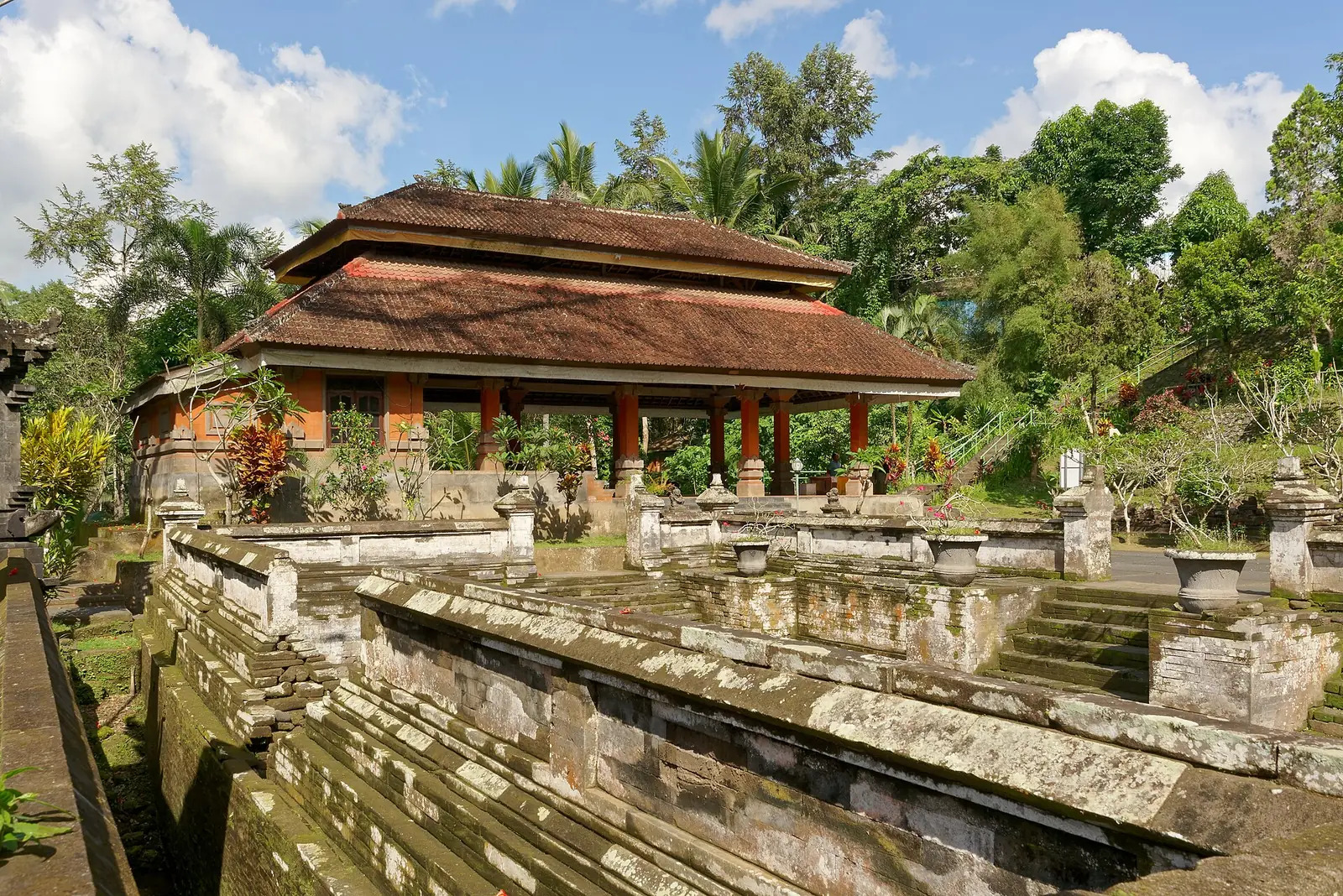
Dutch archaeologists came upon the cave in 1923, but the bathing place in front of it lay buried until 1954, when excavation uncovered stone pools fed by spouts held by six female figures. Down the slope toward the river are the remains of Buddhist shrines, carved stupas and parasols, so this one place kept both paths side by side, as Bali has long done. The Desawarnana, also called the Nagarakretagama, written in 1365, lists Lwa Gajah among the Buddhist and Shaiva foundations of Bali.
The life of this place
- c. 11th centuryThe cave sanctuary is carved.
- 1365The Nagarakretagama names Lwa Gajah.
- 1923Dutch archaeologists record the cave.
- 1954The bathing pools are excavated.
About 4 km east of Ubud at Bedulu. Sarong required; the steps down to the cave are steep.