01A capital of wood
Suklenmung, remembered as the Gargayan Raja, moved the Ahom seat to Garhgaon in 1540. The city had no stone wall. Instead a belt of planted bamboo two kos deep ran round it, with raised roads from four gates to the palace and a moat that stayed full of water. In 1562 the Koch general Chilarai came up the Brahmaputra and occupied it, and the Ahom king had to make terms. A century later, in March 1662, Mir Jumla, Aurangzeb’s governor of Bengal, entered the city. His chronicler Shihabuddin Talish measured the audience hall at 120 cubits on 66 smoothed pillars and wrote that nowhere in the world could wooden houses be built with such carving.
02Rebuilt in brick
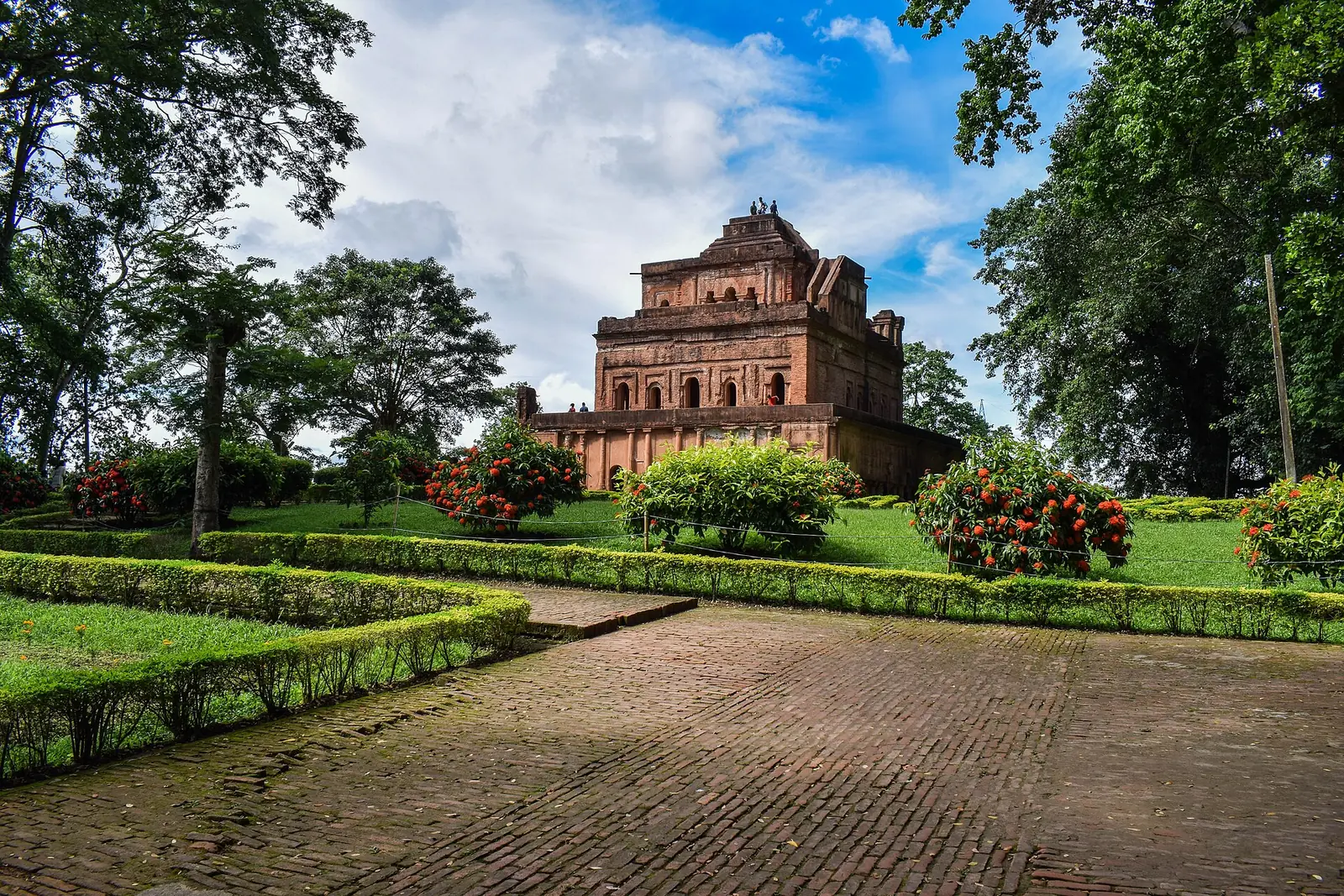
Mir Jumla’s army could not hold Assam through the rains, and Garhgaon came back to the Ahoms, who drove the Mughals out of the west under Lachit Borphukan in 1667–71. In 1747 Pramatta Singha ran a brick wall about five kilometres long round the palace and built a masonry gate. Around 1752 his brother Rajeswar Singha pulled down the old palace and raised the Kareng Ghar that stands now, of brick and lime with storeys climbing in steps. The later kings governed more from Rangpur near Sivasagar, but Garhgaon stayed a royal town until the Burmese invasions of the 1810s and 1820s. The ASI and the Assam government now look after the palace.
The life of this place
- 1540Suklenmung makes Garhgaon the Ahom capital.
- 1562The Koch general Chilarai occupies Garhgaon.
- March 1662Mir Jumla’s Mughal army takes the capital.
- 1747Pramatta Singha builds the brick wall and gate.
- c. 1752Rajeswar Singha rebuilds the palace as the Kareng Ghar.
About 13 km east of Sivasagar; combine it with the Rang Ghar, the Talatal Ghar and the Sivadol.