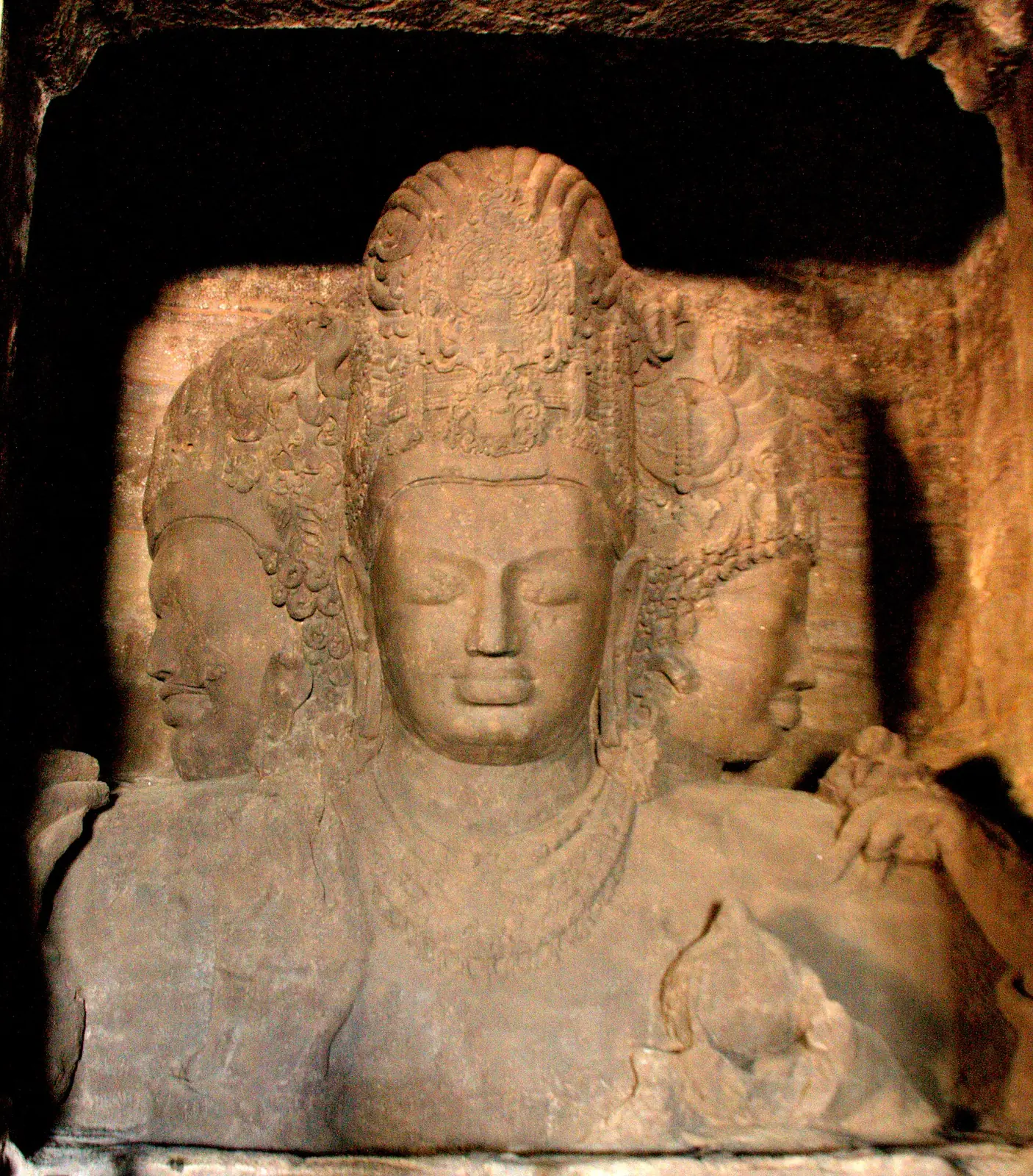
01Three faces of Mahadev
The Great Cave is a pillared hall cut into the hill, with a square linga shrine open on four sides, guarded by dvarapalas. Facing the north entrance, set back in the rock, are the three faces of Sadashiva: Tatpurusha calm in the centre, Aghora fierce on the left with snakes in his hand, Vamadeva gentle on the right with a lotus. Around the walls are great panels: Shiva marrying Parvati, Gangadhara receiving the Ganga in his hair, Ardhanarishvara, Andhakasura-vadha, Ravana shaking Kailasa, and Nataraja. Scholars place the cave in the mid-6th century and disagree over the patron, with the Kalachuri king Krishnaraja most often named.
02Under the Portuguese
The island passed to the Portuguese with Bassein under the treaty of 1534. They called it Elephanta after a large stone elephant near the landing. The cave ceased to be a place of worship, and many of its figures lost arms, legs and faces in the Portuguese period; later British accounts record the damage. The elephant itself collapsed and was carried to Bombay in 1864, and now stands reassembled outside the Dr Bhau Daji Lad Museum at Jijamata Udyan. UNESCO inscribed the caves in 1987. On Mahashivaratri local people still come to offer worship.
The life of this place
- c. mid-6th centuryThe Great Cave is cut with the Sadashiva at its centre.
- 1534The island passes to the Portuguese with Bassein; worship ceases and the panels are damaged in the Portuguese period.
- 1864The fallen stone elephant is moved to Bombay.
- 1987Inscribed as a UNESCO World Heritage Site.
Ferries leave from the Gateway of India, about an hour each way; closed on Mondays. The Elephanta Festival is held in February.