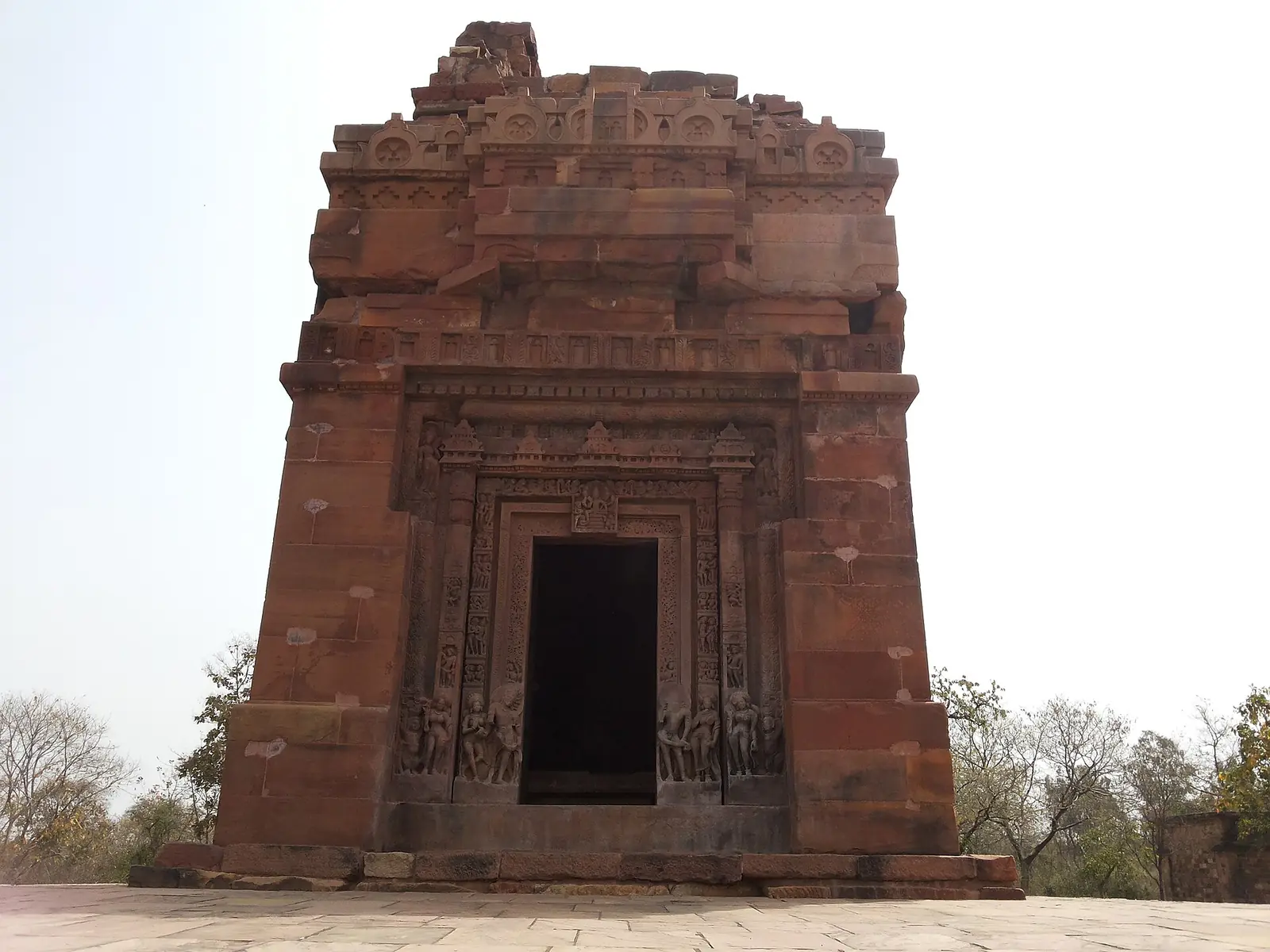
01Three windows on Vishnu
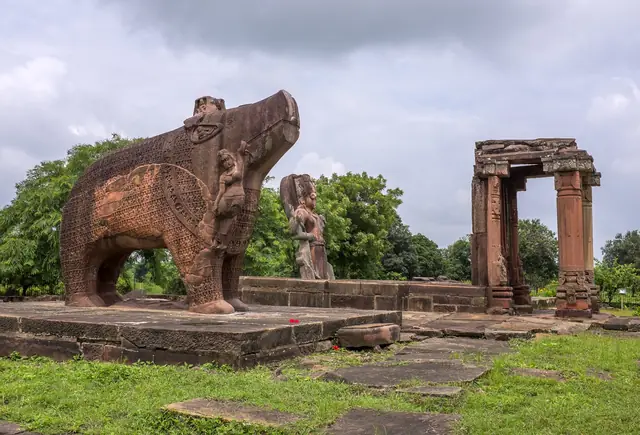
The temple stands on a broad terrace, with a small square sanctum at the centre and four lesser shrines once at the corners. Instead of open doors on three sides, the walls carry great carved panels like windows. On the south Vishnu lies on the coils of Shesha, Lakshmi at his feet, Brahma on the lotus from his navel and Shiva and Parvati on Nandi above. On the east sit Nara and Narayana in tapas at Badrikashrama. On the north Vishnu comes down on Garuda to save Gajendra, the elephant king, from the water-serpent. The doorway on the west is framed by Ganga and Yamuna.
02Found again
Alexander Cunningham’s survey photographed the ruins in 1875, and M. S. Vats of the Archaeological Survey excavated and studied the temple in the 1930s; his memoir, The Gupta Temple at Deogarh, appeared in 1952. The shikhara has fallen. On the hill above, behind the fort walls, stand some thirty Jain temples of the 9th to 12th centuries, and rock-cut images line the cliff over the Betwa.
The life of this place
- c. 500 CEThe temple is built under the Guptas.
- 1875Cunningham’s survey photographs the ruins.
- 1952M. S. Vats publishes The Gupta Temple at Deogarh.
About 33 km from Lalitpur; the nearest large station is Jhansi. Combine with the Jain hill and the Betwa gorge.