01What the pillar says
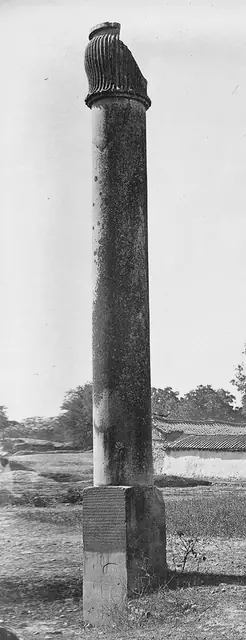
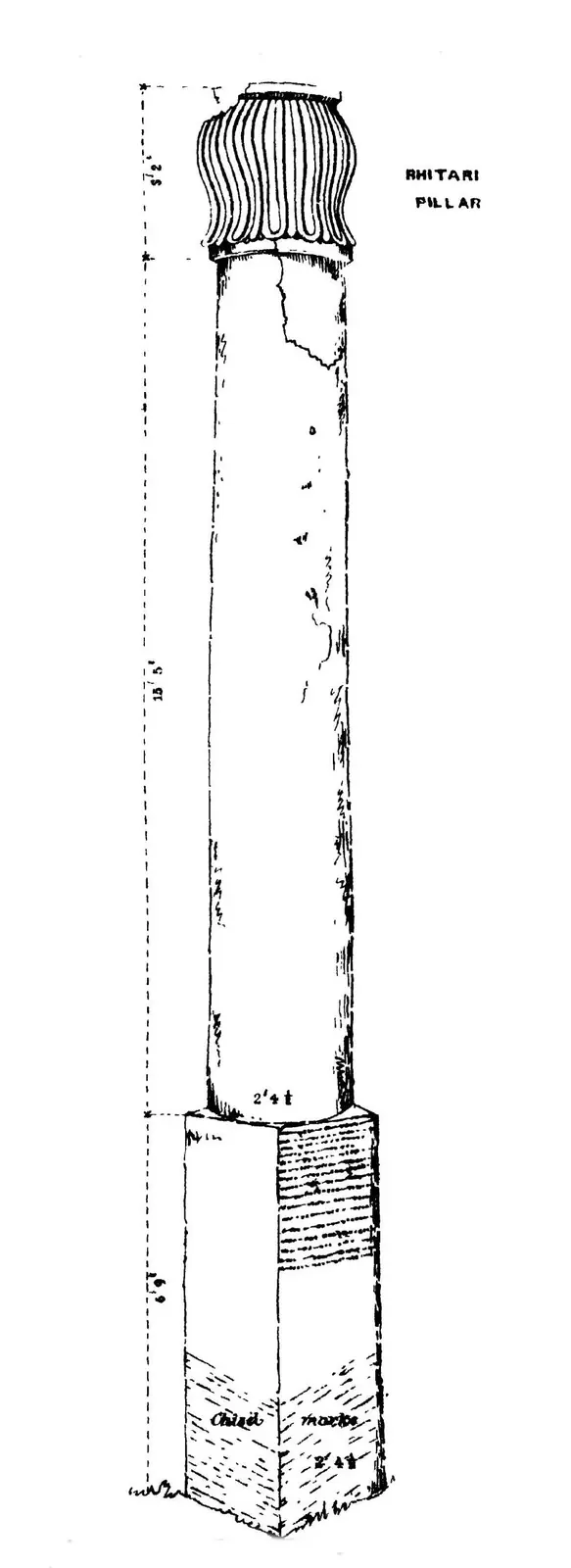
The inscription begins with the line of Gupta kings and then speaks of Skandagupta in his own crisis. When the fortunes of his family were shaken, it says, he spent a night lying on the bare earth, and then defeated the Pushyamitras. Returning victorious, he went to his widowed mother, as Krishna went to Devaki after slaying his foes. When he met the Hunas in battle, the earth shook. The record closes by stating that he set up an image of Bhagwan Vishnu as Sharngin, the bearer of the bow, and granted the village for its worship. The pillar still stands, its top broken, in a field near the village.
02The seal and the ruins
Alexander Cunningham reported the pillar in the 1860s, and the inscription was edited by J. F. Fleet in 1888. Around the pillar lie brick mounds of the Gupta settlement and the remains of a temple. A silver-copper seal found at Bhitari names the Gupta kings from Gupta and Ghatotkacha to Kumaragupta III, son of Narasimhagupta, and has done as much as the pillar to fix the order of the later Guptas. Bhitari is a few kilometres from Saidpur, near the Ganga between Varanasi and Ghazipur.
The life of this place
- c. 455–467 CESkandagupta raises the pillar and installs an image of Vishnu.
- 1888Fleet publishes the Bhitari pillar inscription in the Corpus Inscriptionum Indicarum, Vol. III.