The minar was begun by Qutb-ud-din Aibak around 1199 and raised higher by Iltutmish. What is true is that the mosque at its foot was built from demolished temples, as its own inscription says, and that the iron pillar beside it is a Gupta-era standard of Bhagwan Vishnu.
The proof
- Arabic inscriptions on the minar name Aibak, Iltutmish and, after lightning damage in 1369, Firuz Shah Tughlaq, who rebuilt the top storeys.
- The east gate inscription of the Quwwat-ul-Islam mosque records that materials of 27 temples, each built at a cost of 20 lakh dehliwals, went into it.
- The iron pillar’s Sanskrit inscription says King Chandra raised it on the hill called Vishnupada as a dhvaja of Vishnu.
01What the stones say
Walk the Qutb complex slowly. The mosque’s colonnades are made of temple pillars: you can still see kirtimukhas, bells on chains and defaced figures carved on them, set up by the builders of 1190s Delhi. The gate inscription states it plainly. The minar is another matter. Its fluted storeys carry bands of Arabic, and its masonry is laid in the Sultanate manner. Calling the minar a Vishnu Stambh takes attention away from the evidence that is real and undisputed: twenty-seven temples went into the mosque, and an iron dhvaja of Vishnu, older than the Sultanate by eight centuries, stands in its courtyard.
Read on
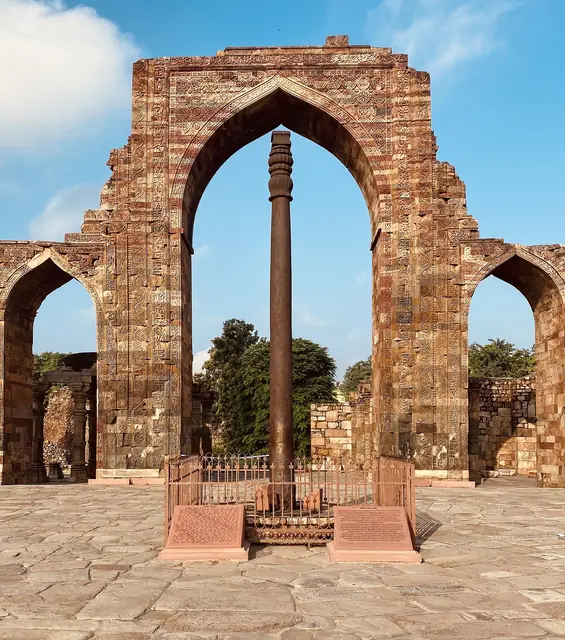
Iron pillar of Delhi
A 7.2-metre wrought-iron column of about six tonnes, forged as a dhvaja of Vishnu and still almost free of rust after sixteen centuries.
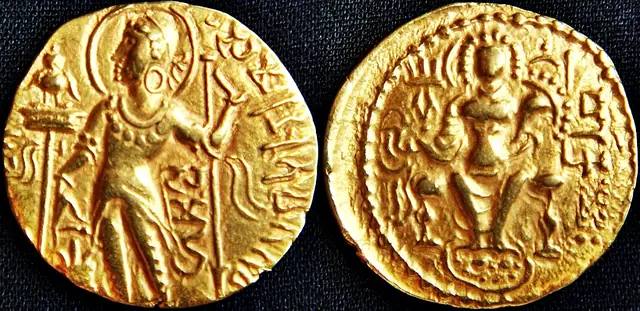
Gupta empire
From Chandragupta I in 319–320 CE to Skandagupta in the 460s, the Guptas built the largest Indian empire since the Mauryas. Their age gave Bharat Kalidasa, Aryabhata, the decimal place-value system in common use, the first stone temples of the north, and Nalanda.
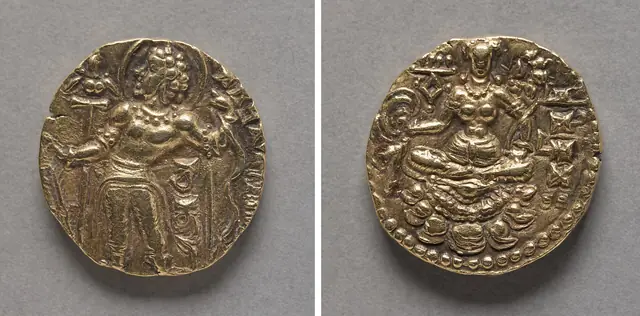
Chandragupta II Vikramaditya
Chandragupta II ended three centuries of Shaka rule in Malwa and Gujarat, brought the western ports into the Gupta realm and took the title Vikramaditya. His reign is the high noon of the Gupta age that Faxian walked through.