
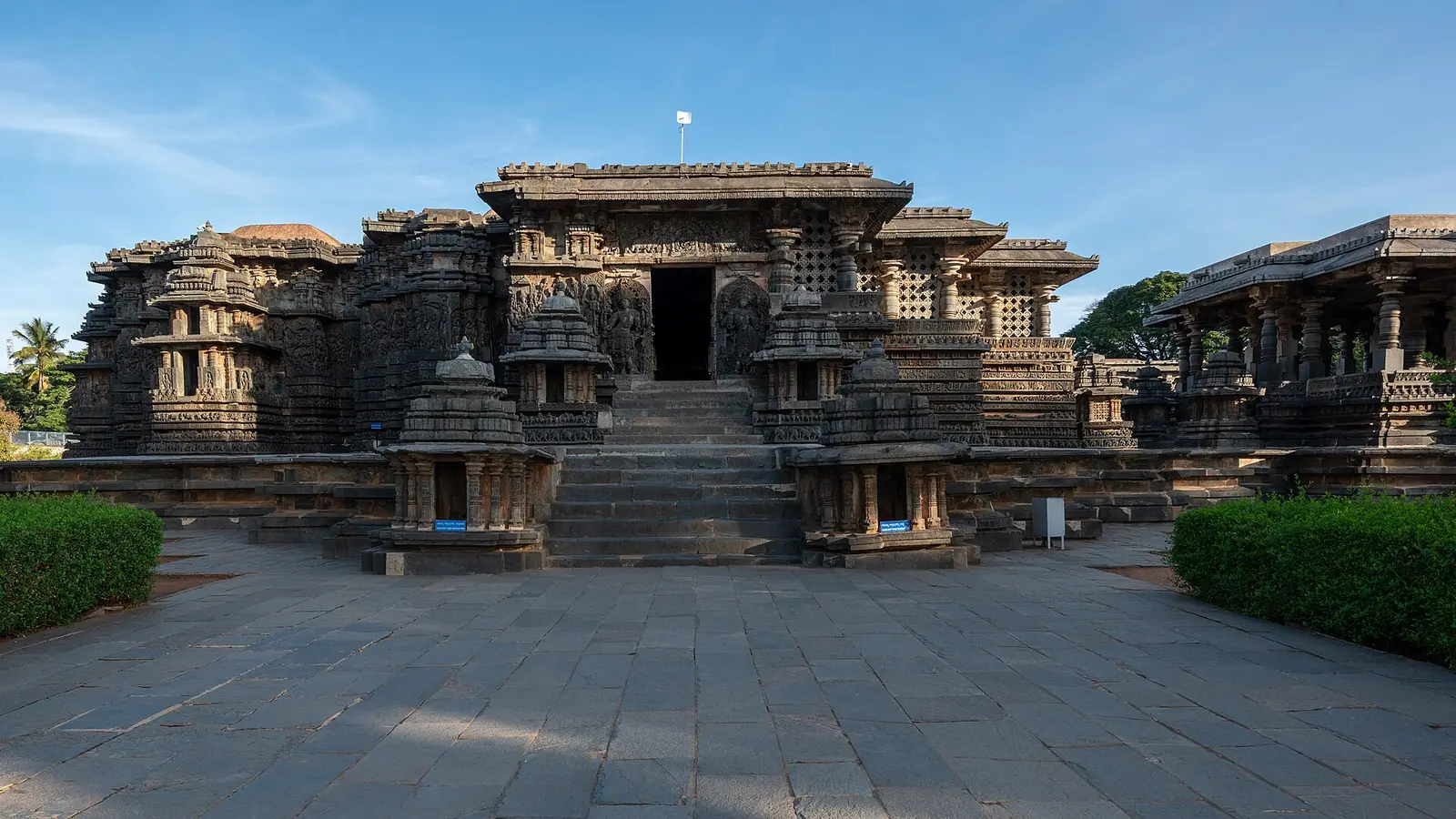
Hoysala
Southern Karnataka · 1117 to c. 1300
The Hoysala kings of Dorasamudra built some 1,500 temples in the 12th and 13th centuries, of which about a hundred survive. Vishnuvardhana began the Chennakeshava at Belur in 1117; the Hoysaleswara at Halebidu, his capital, followed within a few decades; the Keshava at Somanathapura was consecrated in 1268. All three stand on a star-shaped platform, the jagati, which doubles as the path of pradakshina.
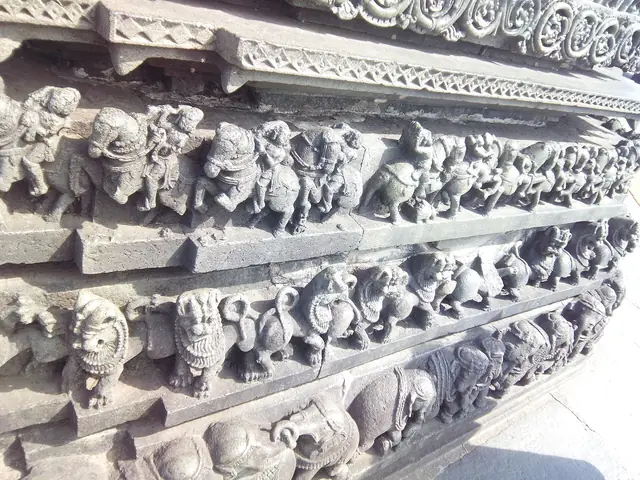
The walls are built of chloritic schist, soft when quarried and hard once exposed, and carved in horizontal friezes from the ground up: elephants for strength, then horsemen, then scrolls, then scenes from the Ramayana, the Mahabharata and the Bhagavata, then rows of deities, each frieze running the full length of the building without repeating. The sculptors often signed their work; the names of Mallitamma, Dasoja and Chavana are cut into the stone. Inside, the pillars are lathe-turned and the ceilings are carved lotus domes. In 2023 Belur, Halebidu and Somanathapura together were inscribed as a UNESCO World Heritage Site.
How to recognise it
- Star-shaped jagati platform
- Horizontal friezes of elephants, horsemen and Itihasa scenes
- Soapstone carving of extreme fineness
- Signed sculptures
- Lathe-turned pillars, lotus ceilings
Great examples
 Standing
Chennakeshava Temple, Belur
Vishnuvardhana’s temple on the Yagachi, consecrated in 1117 after his victory over the Cholas at Talakad. It has been in worship for nine hundred years and its soapstone carving set the Hoysala standard.
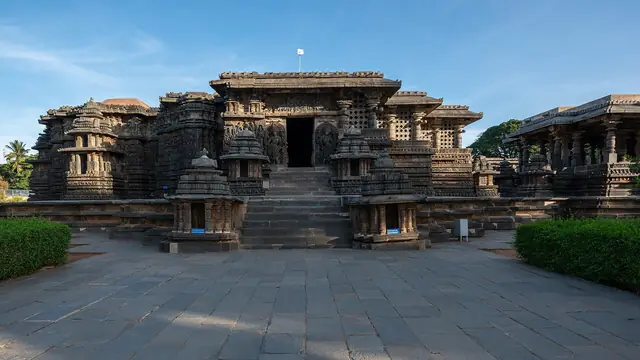 Ruined
Hoysaleswara Temple, Halebidu
The twin Shiva temple of Dorasamudra, the Hoysala capital, covered from plinth to eaves in carving. The city was sacked by Malik Kafur in 1311 and again by Muhammad bin Tughluq’s army in 1326–27; its name became Halebidu, ‘the old ruined town’.
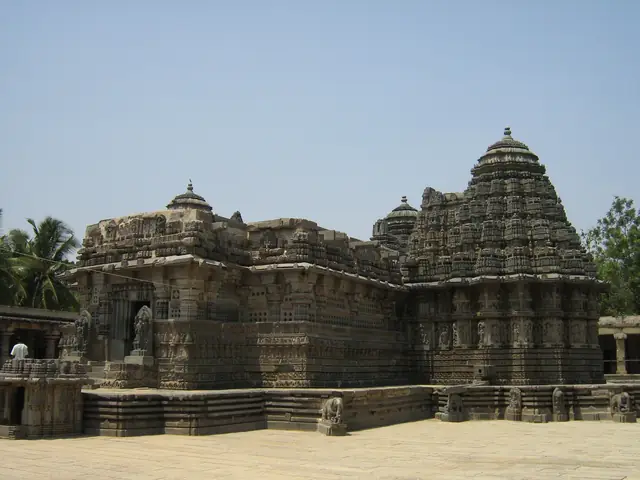 Standing
Keshava Temple, Somanathapura
A complete late Hoysala temple of three star-shaped shrines, built by a general in 1268 in the village he founded. Its sculptors signed their work.
 Standing
Melukote (Tirunarayanapura)
The hill town where Ramanujacharya lived for about twelve years in the Hoysala country. Its festival murti, the tradition says, he brought back from Delhi himself.