
सुखकर्ता दुःखहर्ता वार्ता विघ्नांची।
नुरवी पुरवी प्रेम कृपा जयाची।
सर्वांगी सुंदर उटी शेंदुराची।
कंठी झळके माळ मुक्ताफळांची॥१॥
जय देव जय देव जय मंगलमूर्ती।
दर्शनमात्रे मनकामना पुरती॥धृ॥
रत्नखचित फरा तुज गौरीकुमरा।
चंदनाची उटी कुंकुमकेशरा।
हिरेजडित मुकुट शोभतो बरा।
रुणझुणती नूपुरे चरणी घागरिया॥२॥
लंबोदर पीतांबर फणिवरबंधना।
सरळ सोंड वक्रतुंड त्रिनयना।
दास रामाचा वाट पाहे सदना।
संकटी पावावे निर्वाणी रक्षावे सुरवरवंदना॥३॥
Sukhakarta dukhaharta varta vighnanchi,
nuravi puravi prem kripa jayachi,
sarvangi sundar uti shendurachi,
kanthi jhalake mal muktaphalanchi.
Jay dev jay dev jay mangalamurti,
darshanamatre manakamana purati.
Ratnakhachit phara tuj Gaurikumara,
chandanachi uti kunkumakeshara,
hirejadit mukut shobhato bara,
runajhunati nupure charani ghagariya.
Lambodar pitambar phanivarabandhana,
saral sond vakratunda trinayana,
das Ramacha vat pahe sadana,
sankati pavave nirvani rakshave suravaravandana.
Meaning
Giver of joy, remover of sorrow, he leaves not even a trace of obstacles; his grace pours out love. Lovely in every limb, smeared with vermilion, a necklace of pearls shining at his throat.
Victory, O God, victory, O God, victory to the auspicious form! At the mere sight of you the heart’s wishes are fulfilled.
For you, son of Gauri, a jewelled seat; sandal paste with kumkum and saffron; a diamond-studded crown that suits you well; anklets and little bells jingling at your feet.
Big-bellied, in yellow silk, with the king of serpents as your belt; straight trunk, curved trunk, three-eyed one. Rama’s servant waits for you at home: come in times of trouble, protect at the final hour, O you whom the best of devas worship.
About this bhajan
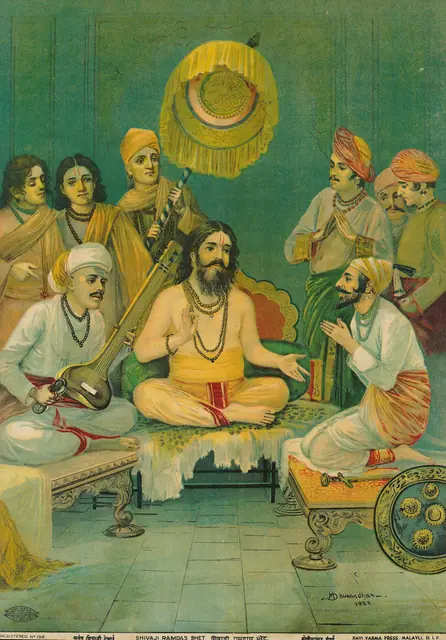
Samarth Ramdas composed this aarti after darshan of Mayureshwar at Morgaon, the first of the Ashtavinayaka shrines near Pune, and his signature is in the last stanza: “das Ramacha”, Rama’s servant. It is the first aarti of every Ganesh puja in Maharashtra and the sound of Ganeshotsav in every lane, with cymbals and clapping on the refrain “jay dev jay dev”. The third eye in the last stanza recalls the Morgaon murti, where Ganesha is shown with three eyes.
Samarth Ramdas, Ganesh aarti (text as given in Wikipedia’s cited editions: Prarthana, 2007; Sacred Songs of India, 2003)