01Lava’s city, Prasenajit’s capital
In the Uttara Kanda of the Valmiki Ramayana, Shri Rama, before he leaves the world, sets Kusha on the throne of Kushavati and Lava on that of Shravasti. In the Buddha’s day Shravasti was the seat of King Prasenajit of Kosala and one of the six great cities of the Ganga plain. The merchant Anathapindika bought the grove of Prince Jeta, so the texts say, by covering its ground with gold coins, and gave it to the Sangha as the Jetavana. The Buddha spent some twenty-four rainy seasons here, and many of his discourses open with the words ‘at Shravasti, in Jeta’s grove’. Jains revere the town as the birthplace of the third Tirthankara, Sambhavanath.
02Ruin and rediscovery
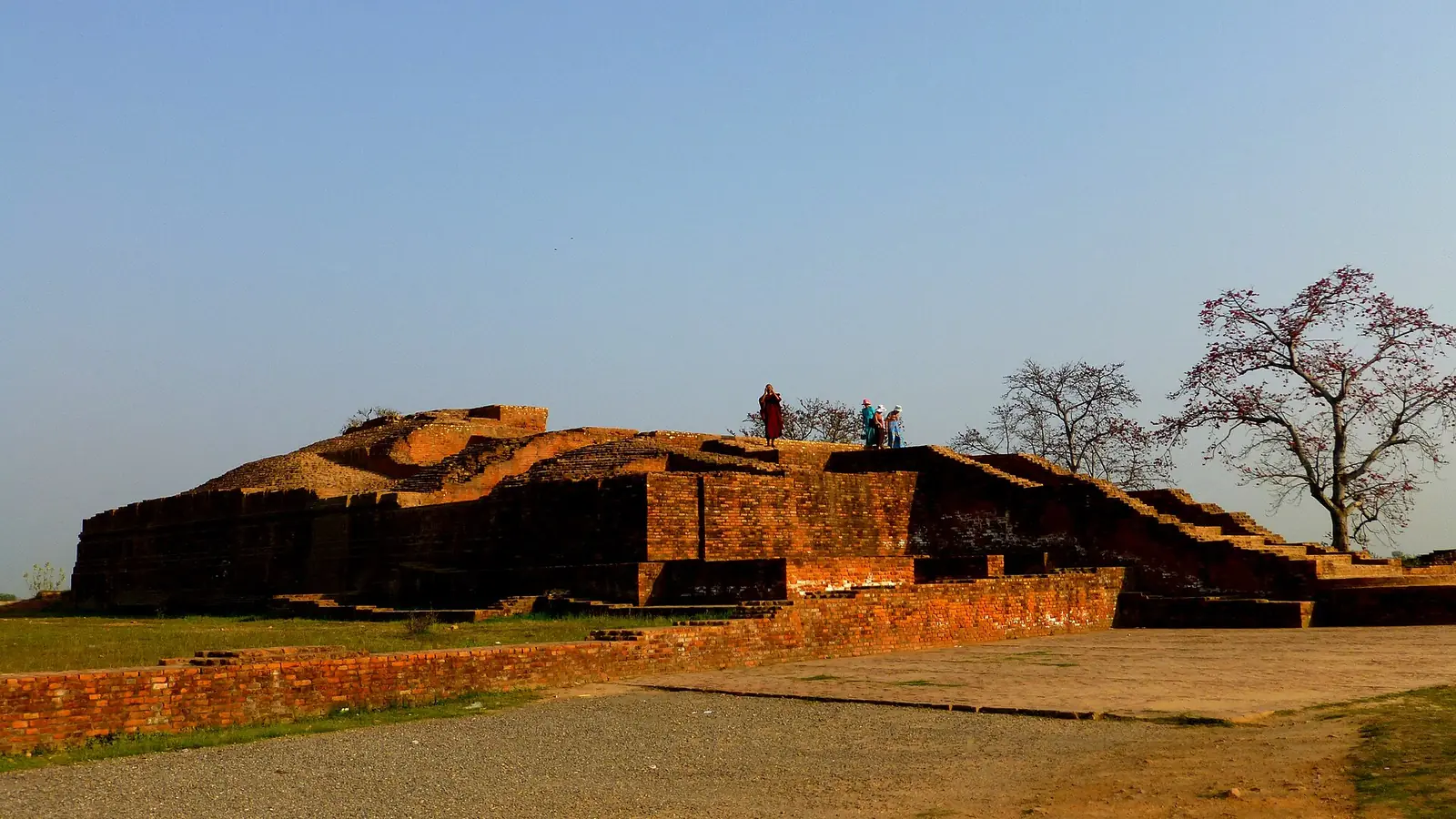
Faxian, around 400 CE, found the city thinly peopled, and Xuanzang in the 630s found it in ruins. Monks still lived at the Jetavana: a copper plate of the Gahadavala king Govindachandra of Kannauj, of the 12th century, grants villages to the community there. Alexander Cunningham identified Saheth as the Jetavana and Maheth as the walled city in 1863, and excavations by Hoey, Vogel, Marshall and Daya Ram Sahni between 1884 and 1911 uncovered monasteries, stupas, the city gates and Jain temples. Monasteries built by Thai, Sri Lankan, Myanmar and Korean Buddhists now stand along the road.
The life of this place
- 6th–5th century BCECapital of Prasenajit of Kosala; Anathapindika gives the Jetavana to the Buddha.
- c. 400 CEFaxian finds the city thinly peopled.
- c. 636Xuanzang finds Shravasti in ruins.
- 12th centuryGovindachandra Gahadavala grants villages to the Jetavana monastery.
- 1863Cunningham identifies Saheth-Maheth as Shravasti.
- 1884–1911Excavations uncover the Jetavana and the walled city.
Shravasti is about 175 km from Lucknow, near Balrampur. The Jetavana park is a quiet place to sit in the evening.