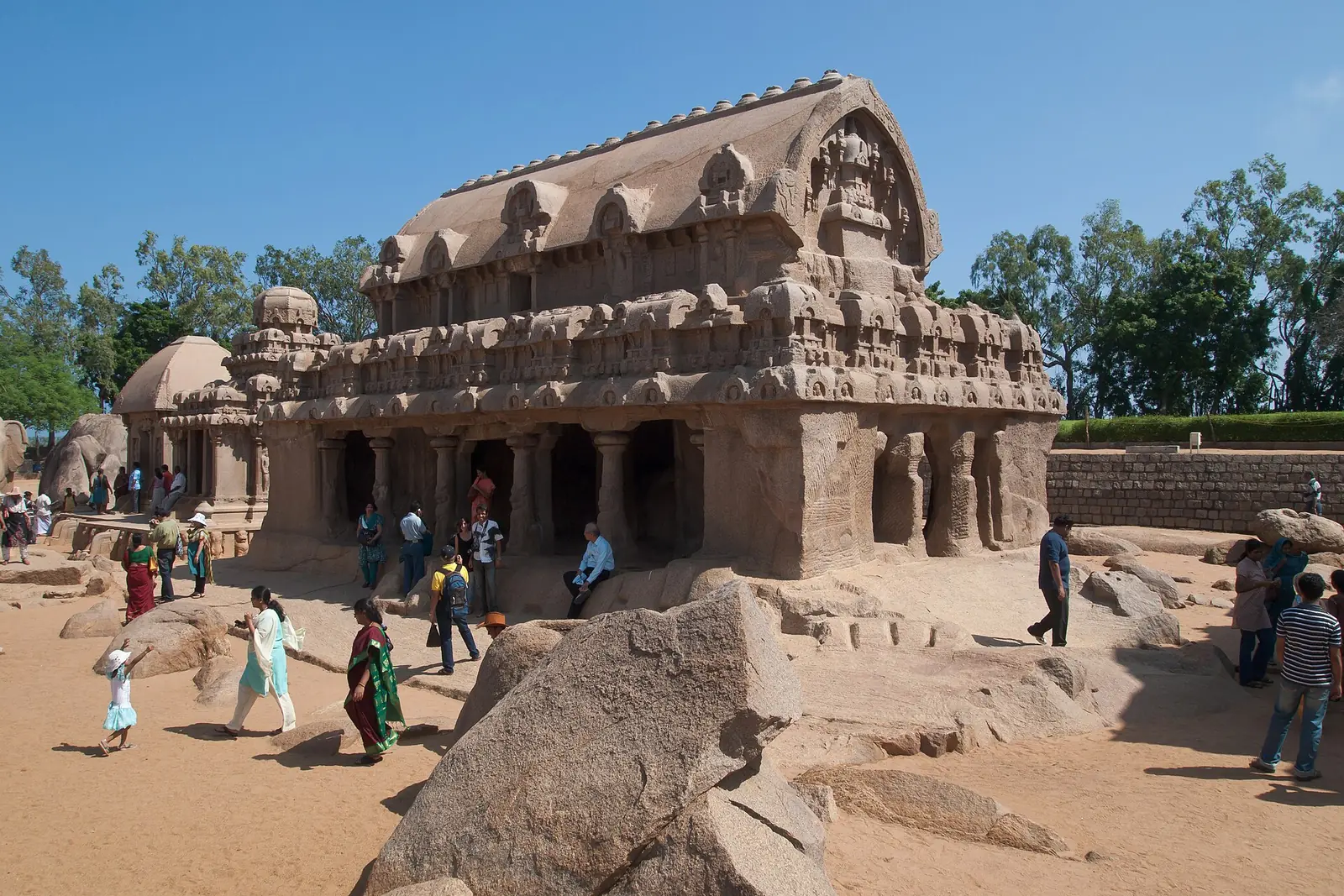
01Temples cut from boulders
The rathas are named after the Pandavas and Draupadi, though they were never chariots and never temples to the Pandavas; the names came later. Draupadi’s ratha is a hut-shaped shrine of Durga. Arjuna’s is a small storeyed Shiva temple. Bhima’s is long with a barrel roof. Dharmaraja’s, the tallest, carries a royal inscription of Narasimhavarman I. Nakula-Sahadeva’s is apsidal, with a life-size elephant beside it. They were left unfinished, and that is their gift: they show every stage of how the Pallava carvers worked down from the top.
02The Descent of the Ganga
A short walk away, two huge boulders are carved as one scene about 27 m long. A natural cleft down the middle was once fed with water so that it ran like a river, and nagas swim up it with folded hands. Around it devas, rishis, hunters, elephants and even a cat in tapas gather. The ascetic standing on one leg is read as Bhagiratha bringing down the Ganga, or as Arjuna winning the Pashupata from Shiva; both readings are old. It is among the largest open-air reliefs anywhere.
The life of this place
- 630–668The rathas are carved under Narasimhavarman I, who gave the port the name Mamallapuram.
- 1984Inscribed by UNESCO with the Mahabalipuram group.
One ticket covers the rathas and the Shore Temple. The Penance relief is in town, free to view.