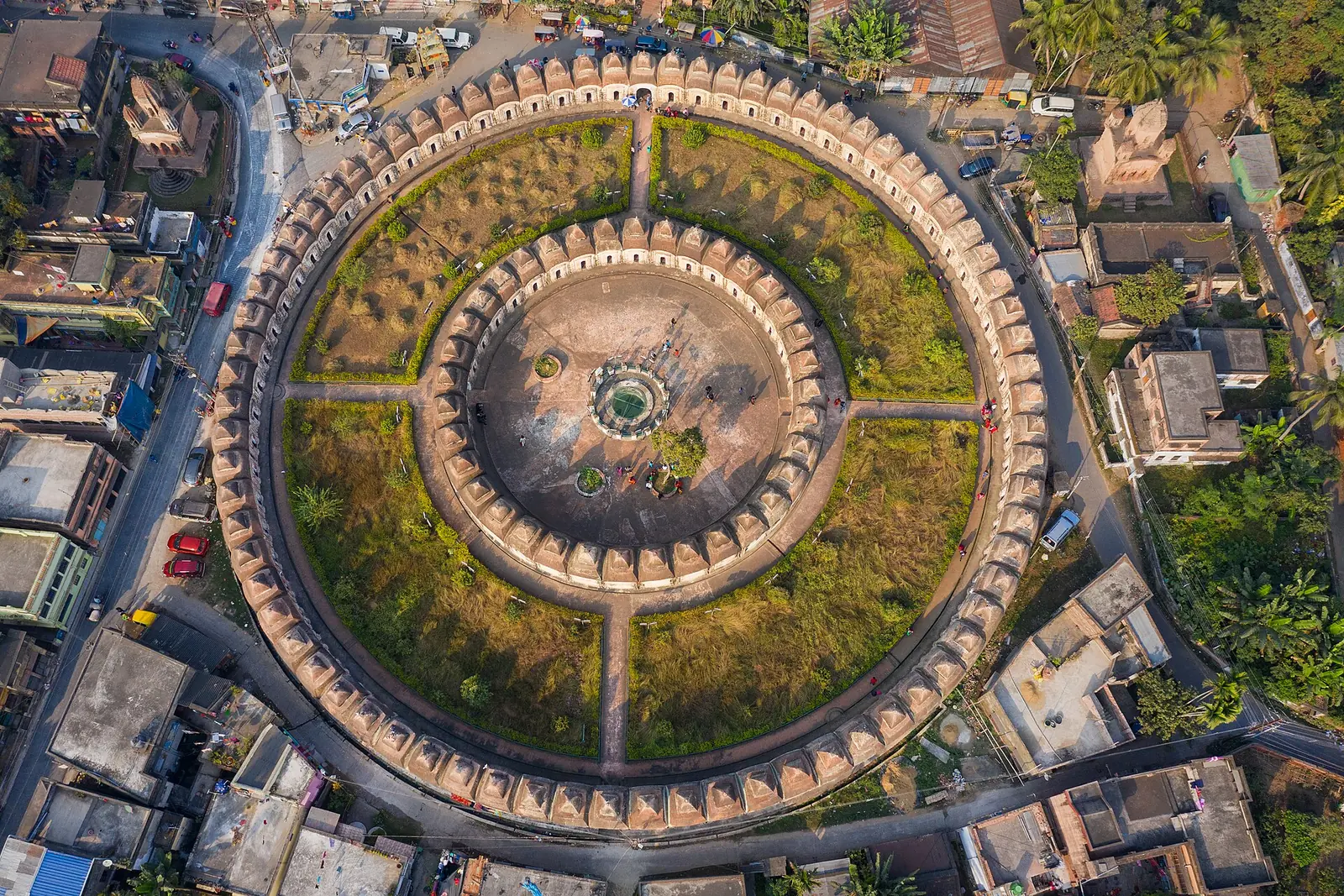
01A japa mala in brick
Maharaja Tejchand of Bardhaman completed the Naba Kailash in 1809. Seventy-four small aat-chala temples form the outer ring and thirty-four the inner, so that a pilgrim walking round counts 108, as on a rosary. Every temple has its own linga. Those of the inner ring are white; in the outer ring white and black alternate. The design lets a person standing at the centre see every linga at once. Panels of terracotta over the doors show the Ramayana, the Mahabharata and hunting scenes.
02The Rajbari temples
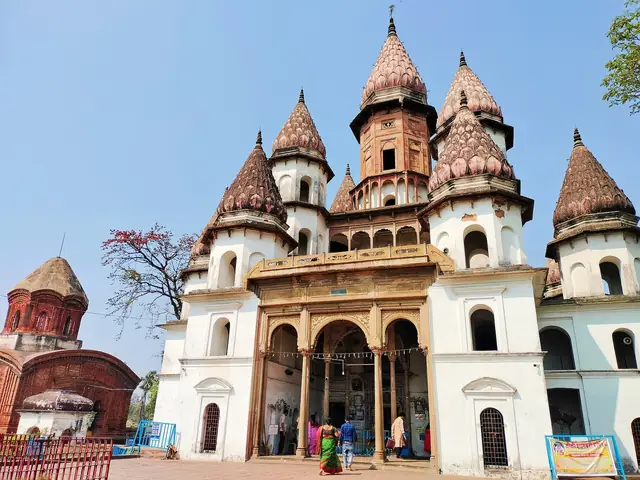
Across the road, in the old Rajbari compound, the Bardhaman family built Krishna temples through the 18th century. The Lalji temple, a twenty-five-spired pancha-vimshati ratna temple, was raised in 1739 by the queen mother Braja Kishori Devi, and the Krishnachandra temple, also with twenty-five spires, followed in the 1750s. Their walls are among the best terracotta work in Bengal. Kalna was a seat of the Bardhaman Raj on the river and a stop on the Vaishnava route to Nabadwip.
The life of this place
- 1739The Lalji temple is built in the Rajbari compound.
- 1809Maharaja Tejchand completes the 108 Shiva temples of the Naba Kailash.
Ambika Kalna is on the Howrah–Katwa line, about 2 hours from Howrah; the Rajbari and Naba Kailash face each other and are ASI-protected.