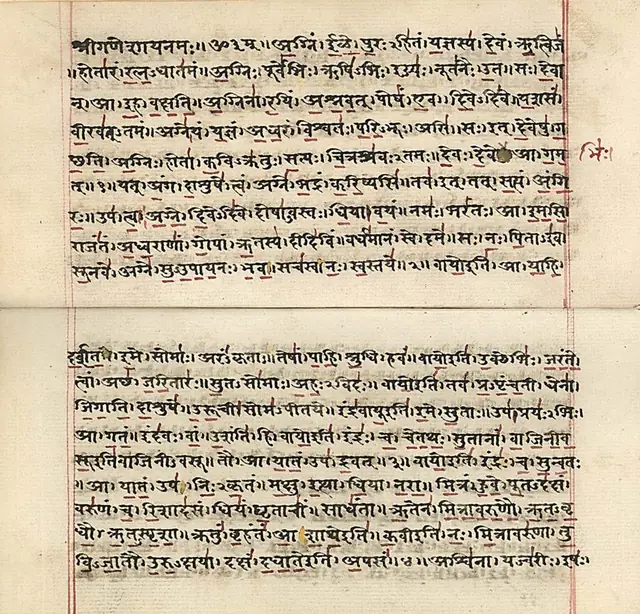
Baudhayana’s Shulbasutra states the rule clearly, for any rectangle, as part of building Vedic fire-altars, but it gives no proof in the Greek sense. The rule was also known in Old Babylonia, whose clay tablet Plimpton 322 lists such triples around 1800 BCE.
The proof
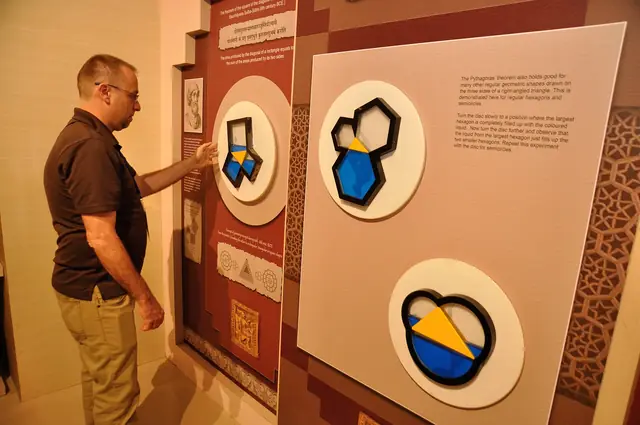
- Baudhayana Shulbasutra: the diagonal rope of a rectangle produces both areas that its length and breadth produce separately.
- The Shulbasutras also give the square root of 2 as 1 + 1/3 + 1/(3·4) − 1/(3·4·34), correct to five decimal places.
01Geometry for the yajna
The Shulbasutras are manuals of the cord, shulba, used to lay out altars whose shapes and areas the ritual fixes exactly: a falcon-shaped altar, a square turned into a circle of equal area. The diagonal rule is used again and again, and the text clearly knows it holds for every rectangle. The Indian claim is strong without being stretched. Say that the rule is stated generally in the Shulbasutras, with remarkable approximations. Do not say it was proved, and do not say no one else knew it.
Read on
Baudhayana
Baudhayana, a teacher of the Taittiriya branch of the Krishna Yajurveda, wrote the oldest of the Shulba Sutras, the rules for measuring out fire altars with cords. It states the relation of the sides and diagonal of a rectangle, the theorem the world now names after Pythagoras.