
ठुमक चलत रामचंद्र बाजत पैंजनियाँ॥
किलकि किलकि उठत धाय गिरत भूमि लटपटाय।
धाय मात गोद लेत दशरथ की रनियाँ॥
अंचल रज अंग झारि विविध भाँति सो दुलारि।
तन मन धन वारि वारि कहत मृदु बचनियाँ॥
विद्रुम से अरुण अधर बोलत मुख मधुर मधुर।
सुभग नासिका में चारु लटकत लटकनियाँ॥
तुलसीदास अति आनंद देख के मुखारविंद।
रघुवर छबि के समान रघुवर छबि बनियाँ॥
Thumak chalat Ramachandra bajat painjaniyan.
Kilaki kilaki uthat dhaya girat bhumi latapataya,
dhaya mat god let Dasharath ki raniyan.
Anchal raj ang jhari vividh bhanti so dulari,
tan man dhan vari vari kahat mridu bachaniyan.
Vidrum se arun adhar bolat mukh madhur madhur,
subhag nasika mein charu latakat latakaniyan.
Tulsidas ati anand dekh ke mukharavind,
Raghuvar chhabi ke saman Raghuvar chhabi baniyan.
Meaning
Little Ramachandra toddles along, his anklets ringing.
Squealing with delight he gets up, runs, stumbles and falls to the ground; Dasharatha’s queens run to lift him into their laps.
They brush the dust from his body with the edge of their saris, pet him in every way, offer up body, mind and wealth for him, and speak softly to him.
His lips are red as coral and he babbles sweetly; from his lovely nose hangs a pretty pendant.
Tulsidas is overjoyed to see his lotus face: Raghuvar’s beauty can be compared only with Raghuvar’s own beauty.
About this bhajan
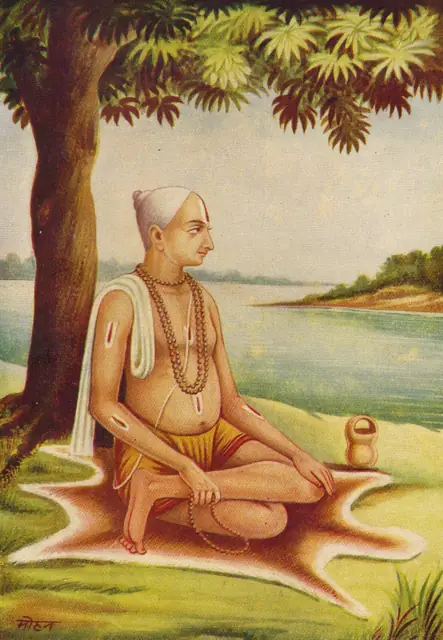
Attributed to Tulsidas. The pada is a picture of Rama at the age of first steps, and the bells on his ankles give it its rhythm. Pandit Vishnu Digambar Paluskar’s singing in the early twentieth century carried it into every music school, and it is still among the first bhajans a child learns. On Ram Navami it is sung beside the cradle of Ram Lalla. We could not trace it to a numbered pada in Tulsidas’s collected works, so the name in its last line is the main basis for the attribution.
Traditional bhajan text as on Kavita Kosh (bhajan section); attributed to Tulsidas