
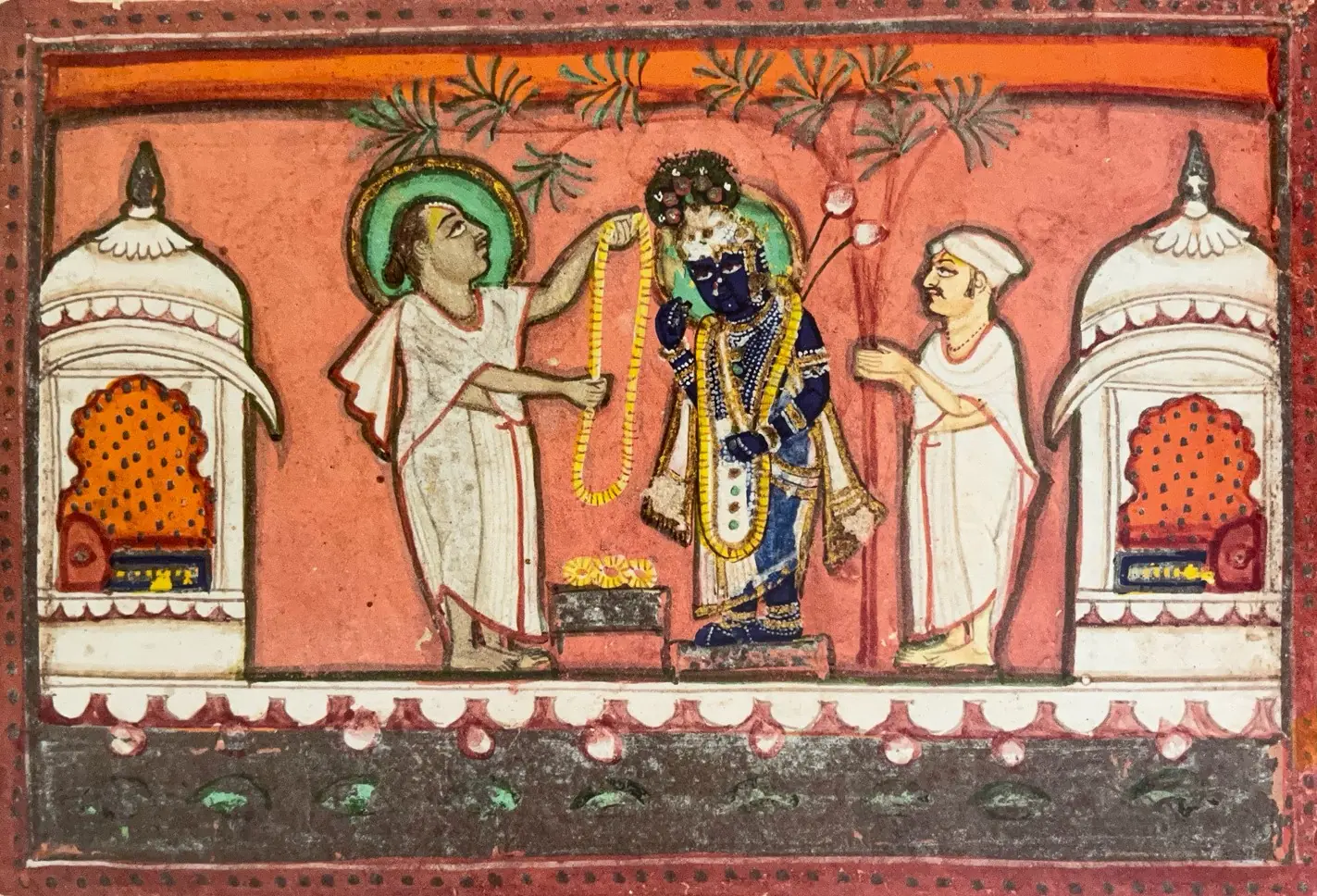
Shri Vallabhacharya
1479–1531 CE · Born at Champaranya (Chhattisgarh) to a Telugu family; Gokul, Govardhan, Kashi · Sanskrit, Braj
VallabhacharyaVallabha was born in 1479 at Champaranya near Raipur, while his parents, Lakshmana Bhatta and Illamma, a Telugu family of Vedic scholars from the Godavari country, were on the road from Kashi. He studied in Kashi as a boy and is remembered for his command of the Shastras while still young. The sampradaya tells that he won a great debate at the court of Vijayanagara and was honoured there as Acharya.
His teaching is Shuddhadvaita, pure non-dualism: the world is Brahman itself and is real, not an illusion laid over Brahman, and Shri Krishna is the highest Brahman. The way to him is pushti, his grace, freely given, received through loving seva rather than earned by effort. That is why the path is called the Pushti Marga.
In 1494, on the night of Shravana Shukla Ekadashi at Gokul, the tradition says Shri Krishna appeared to Vallabha and gave him the Brahmasambandha mantra, by which a devotee dedicates everything to the Lord. He found the svarupa of Shrinathji on Govardhan and began its seva, now kept at Nathdwara. He walked round Bharat three times, and the places where he spoke on the Bhagavata are kept as his eighty-four baithaks.
He wrote the Anubhashya on the Brahma Sutras, the Subodhini on the Bhagavata and sixteen short works, the Shodasha Granthas. Madhurashtakam, where everything about the Lord of Mathura is sweet, is sung in his name. In 1531 he took jal samadhi in the Ganga at Kashi. His son Vitthalnatha gathered the Ashtachhap poets, among them Surdas.
Works
- Anubhashya on the Brahma Sutras
- Subodhini on the Shrimad Bhagavata
- Shodasha Granthas
- Madhurashtakam