
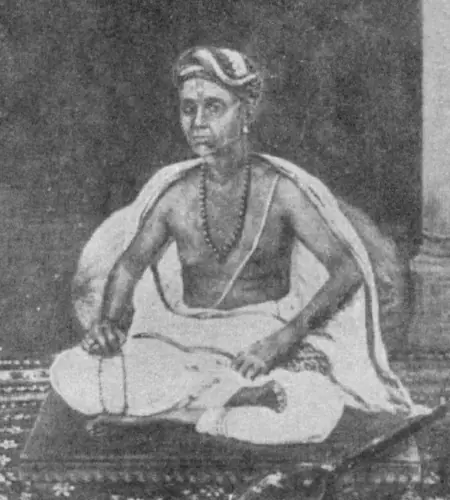
Sadguru Tyagaraja
1767–1847 CE · Tiruvarur and Tiruvaiyaru on the Kaveri, Tamil Nadu · Telugu, Sanskrit
TyagarajaTyagaraja was born at Tiruvarur in 1767 to Kakarla Ramabrahmam and Sitamma, a Telugu Brahmin family that had settled in the Kaveri delta, and grew up at Tiruvaiyaru, where the five rivers meet. He learnt music from Sonti Venkataramanayya, the leading vidwan of the Thanjavur court, and Rama from his father, who worshipped an image of Sita, Rama and Lakshmana at home.
The tradition says he chanted the name of Rama ninety-six crore times, and that Rama gave him darshan. Most of his songs are addressed to Rama as to a person in the room: pleading, scolding, rejoicing, asking why he delays. He lived on unchavritti, the alms collected while singing in the streets, and when the Maratha king of Thanjavur sent for him with gifts, he answered with a kriti asking whether wealth brings happiness or the nearness of Rama.
Some seven hundred of his kritis survive, in Telugu and Sanskrit, besides two musical plays, the Prahlada Bhakti Vijayam and the Nauka Charitram. He gave the kriti its finished shape, and his sangatis, the step-by-step variations on a line, are how every Carnatic singer learns to unfold a raga. The five Ghana Raga Pancharatna kritis are his crown.
Shortly before his death he took sannyasa. He left the body at Tiruvaiyaru on Pushya Bahula Panchami in January 1847. On that day every year, at the Tyagaraja Aradhana on the bank of the Kaveri, hundreds of musicians sit together and sing the Pancharatnas in one voice.
Works
- About 700 kritis in Telugu and Sanskrit
- Ghana Raga Pancharatna kritis
- Prahlada Bhakti Vijayam and Nauka Charitram (musical plays)
Every bhajan
ऎंदरो महानुभावु लंदरिकि वंदनमु चंदुरु वर्णुनि यंद चंदमुनु हृदया
Endaro Mahanubhavulu
Sadguru Tyagaraja · TeluguShri Ramaनगुमोमु गनलेनि ना जालिँ दॆलिसि नन्नु ब्रोवग रादा श्री रघुवर नी
Nagumomu Ganaleni
Sadguru Tyagaraja · TeluguShri Krishnaसामजवरगमन साधुहृत्सारसाब्जपाल कालातीतविख्यात
Samajavaragamana
Sadguru Tyagaraja · SanskritShri Ramaजगदानन्दकारक जय जानकीप्राणनायक गगनाधिपसत्कुलज राजराजेश्वर
Jagadananda Karaka
Sadguru Tyagaraja · SanskritShri Ramaबंटु रीति कॊलुवु ईयवय्य रामा तुंट विंटि वानि मॊदलैन मदा