
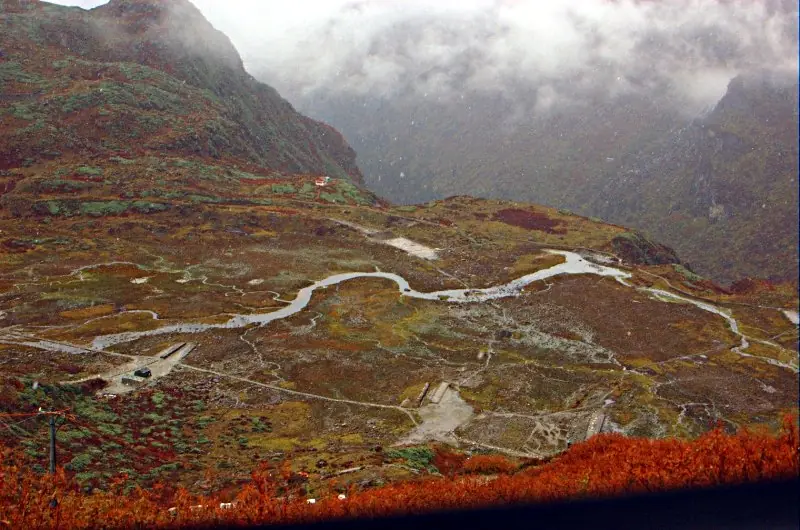
Indian artillery and infantry held both passes and inflicted heavier losses than they took; the Chinese pulled back, and the line has held since.
01Wire on the crest
Sikkim was then an Indian protectorate, and Nathu La, at over 14,000 feet on the old trade road to Lhasa, was held by Indian and Chinese troops a few yards apart. Pushing and shouting matches were common. Major-General Sagat Singh, commanding 17 Mountain Division, decided to mark the border with a wire fence along the crest. On the morning of 11 September 1967, as Indian engineers and men of 18 Rajput laid the wire, Chinese machine guns opened fire from close range, killing many men in the open; the commanding officer of 2 Grenadiers, Lieutenant-Colonel Rai Singh, was wounded.
02The guns answer
Sagat Singh ordered his artillery to fire, and because the Indian posts held the higher ground, their observers could see deep into the Chinese positions. For three days the guns duelled, and the Chinese bunkers below the pass were badly hit. A ceasefire followed on 14–15 September. On 1 October a second clash broke out at Cho La, a few miles north, and the Chinese were again thrown back. Indian figures put Indian dead at 88 and Chinese dead at about 340; Chinese figures differ. The passes stayed in Indian hands, and Nathu La was later reopened for trade and for pilgrims to Kailash Mansarovar.
Nathu La restored the Indian Army’s confidence after 1962 and showed that the Sikkim border would be defended; the soldiers who fell are honoured at the war memorial below the pass.