
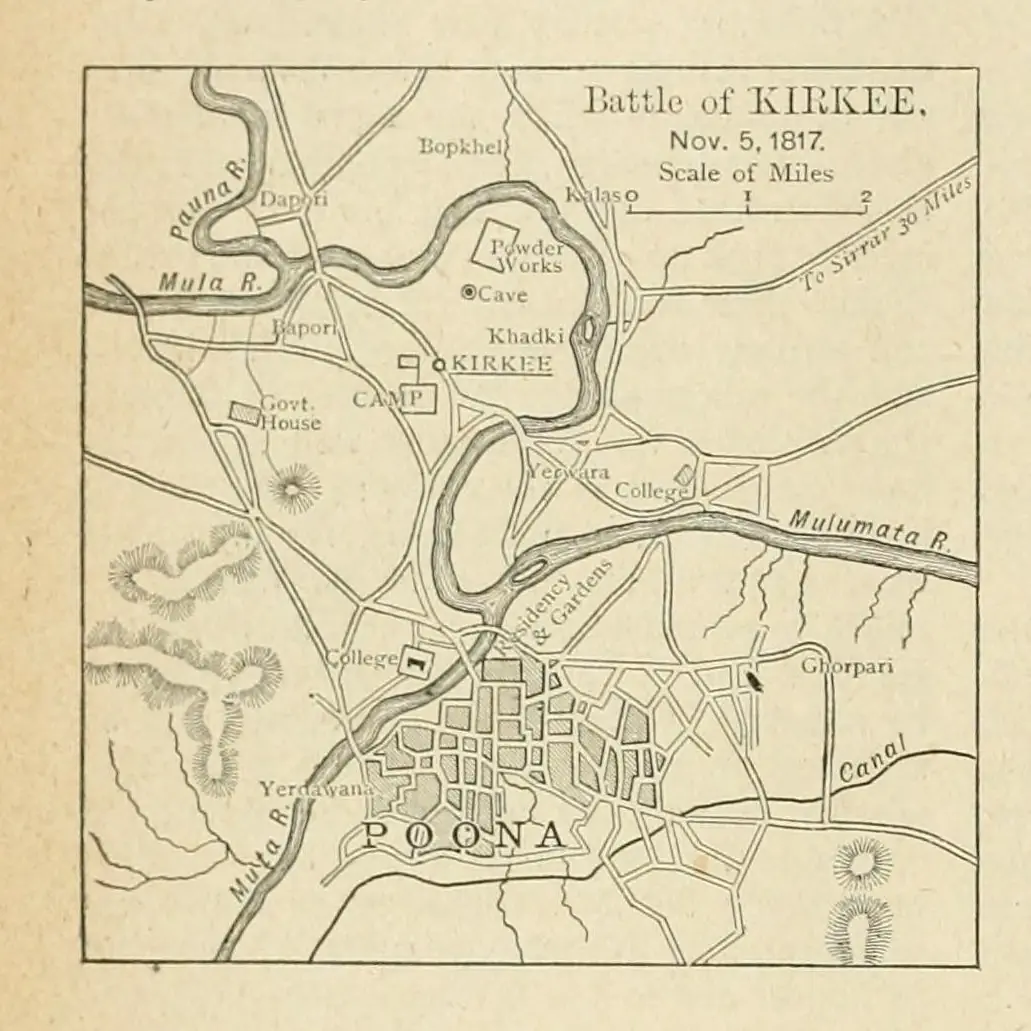
The great Maratha cavalry charge broke on a hidden watercourse and the Company line; the Peshwa withdrew, and Pune was occupied twelve days later.
01The Peshwa’s break
Since the Treaty of Bassein in 1802 Bajirao II had ruled under Company protection, and in June 1817 the Treaty of Poona stripped him of more power. He gathered troops quietly under his general Bapu Gokhale. On 5 November 1817 his army moved out against the small Company force. Elphinstone left the Residency, which the Peshwa’s men burnt with his papers, and joined Colonel Burr’s brigade at Khadki. Grant Duff, who was there, puts the Peshwa’s army at some eighteen thousand horse and eight thousand foot, against under three thousand men on the Company side.
02The charge that broke
Bapu Gokhale led a great mass of horse straight at the Company regiments. In front of the British line lay a deep watercourse that the Maratha riders could not see in the long grass; the leading squadrons plunged into it and were caught by close volleys. Moropant Dixit, one of the Peshwa’s chief commanders, was killed. Bajirao, watching from the Parvati hill, called the army back. The Marathas lost about five hundred men, the Company under a hundred. After another fight at Yerwada, Bajirao left his capital, and on 17 November 1817 the Company occupied Pune.
Khadki opened the Third Anglo-Maratha War and cost the Peshwas their capital; within seven months the office of Peshwa came to an end.