
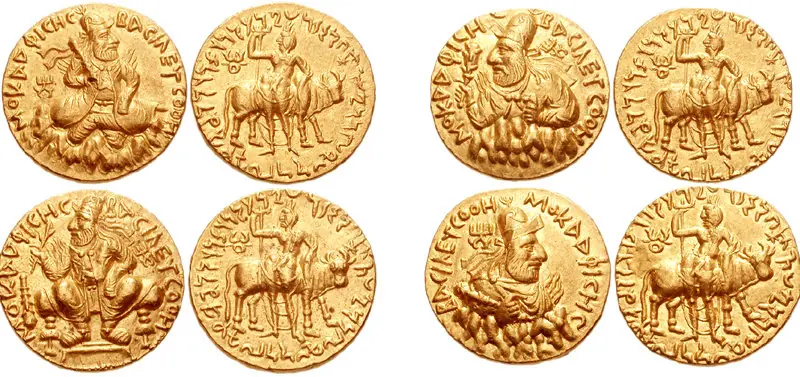
01Maheshvara on Kushan gold
The Kushans ruled from Bactria to Mathura in the first and second centuries CE, and their coins carried the gods of all their subjects. Vima Kadphises, who reigned around 113–127 CE, put on his gold a god with a trident and a bull, and the Kharoshthi inscription on his coins calls him mahishvara, a devotee of Maheshvara. Under Kanishka and Huvishka the same god appears with the Bactrian name OESHO, often with four arms. Huvishka’s coins also show Skanda, Kumara, Vishakha and Mahasena, and a goddess named OMMO, Uma. The last great Kushan king took the name Vasudeva.
02Rabatak and the Kushan court
In 1993 a stone inscription was found at Rabatak in northern Afghanistan. Written in Bactrian in Greek letters, it records Kanishka’s founding of a shrine and names the deities to be honoured there. Among them are Mahasena and Vishakha, both names of Kartikeya, and Umma, Mata Uma. The stone sits far north of the Hindu Kush, in country that later became wholly Buddhist and then Muslim, and it shows how far the worship of Shiva’s family had travelled with Kushan power. It is now in the Kabul Museum.
03Khotan and the Sogdian painters
Aurel Stein dug at Dandan Oilik, a buried oasis town near Khotan, in the winter of 1900–01. Among the painted wooden panels he carried away is a three-headed, four-armed figure seated on a pair of bulls, holding a vajra and other emblems. Many scholars read him as Maheshvara; others see the Sogdian wind god Weshparkar, who was himself painted with Shiva’s form. At Panjikent in Tajikistan, Sogdian murals of the 7th and 8th centuries show Weshparkar three-faced, with a trident. The Sogdians were the great caravan merchants of the Silk Road, and they borrowed the Indian image whole.
04Ganesha in the Dunhuang caves
Dunhuang guards the point where the Silk Road leaves China for the desert. In the Mogao caves there, Cave 285 carries painted dedications of 538 and 539 CE. On its west wall, around the Buddha, sit Maheshvara with three heads riding a bull, Vishnu, Kumara on his peacock, and an elephant-headed Ganesha. They came into China as guardians within Buddhist art, and that is how most Hindu deities travelled east: carried by Buddhist monks and merchants, given new Chinese names, and kept in the temples of another faith for more than a thousand years.
05The devas of Japan
When the monk Kukai came home from China in 806 and founded the Shingon school, he brought mandalas full of Indian devas and mantras written in Siddham, a Brahmi script still painted in Japanese temples. Saraswati became Benzaiten, worshipped at Enoshima and Chikubushima with her biwa lute. Mahakala became Daikokuten, god of the kitchen and the rice store. Ganesha is Kangiten or Shoten, worshipped in secret rites at Matsuchiyama in Tokyo. Lakshmi is Kichijoten, Indra is Taishakuten, Brahma is Bonten, Yama is Enma, Kubera is Bishamonten. Garuda guards temples as Karura.
06A Shiva temple in Quanzhou
Tamil merchant guilds traded at Quanzhou, the great port of southern China, under the Song and Yuan. In 1281 they built a Shiva temple there, and a Tamil inscription records it, with a wish for the welfare of the Mongol emperor. Hundreds of carved granite pieces from Hindu shrines have since turned up in the city: Narasimha, Vishnu on Garuda, scenes of Krishna, a Shivalinga worshipped by a cow. Several were later built into the Kaiyuan Buddhist temple. They are among the sites listed when UNESCO inscribed Quanzhou as a World Heritage Site in 2021.
07Numbers and fables going west
Ideas travelled the same roads as gods. Around 773, an Indian astronomer at the court of the Abbasid caliph al-Mansur in Baghdad brought a Sanskrit siddhanta, generally identified with Brahmagupta’s Brahmasphutasiddhanta; its Arabic version, the Sindhind, taught the Arabs the decimal place value system with zero. Al-Khwarizmi’s book on Indian reckoning carried it to Europe, where the numerals came to be called Arabic. The Panchatantra went the same way: put into Middle Persian by the physician Burzoe in the 6th century, then into Arabic as Kalila wa Dimna by Ibn al-Muqaffa around 750.
08Merchants at Baku and Astrakhan
From the 16th to the 19th century, Hindu and Sikh traders from Multan, Shikarpur and Punjab kept counting houses across Iran, Central Asia and Russia, in Bukhara, Isfahan and the Volga port of Astrakhan. At Surakhani near Baku, where natural gas burns out of the ground, they kept a fire temple, the Ateshgah. Its cells carry inscriptions in Sanskrit in Devanagari script and in Punjabi in Gurmukhi, some opening with an invocation to Shri Ganesh, left by the sadhus and merchants who stayed there. The last of them had gone by the late 19th century; the shrine is now a museum.
No old Hindu community survives in Central Asia or China, but the deities do. In Japan, Benzaiten, Daikokuten and Kangiten are worshipped in thousands of shrines and temples, and Daikoku is one of the Seven Gods of Fortune whose images fill homes at the new year.