
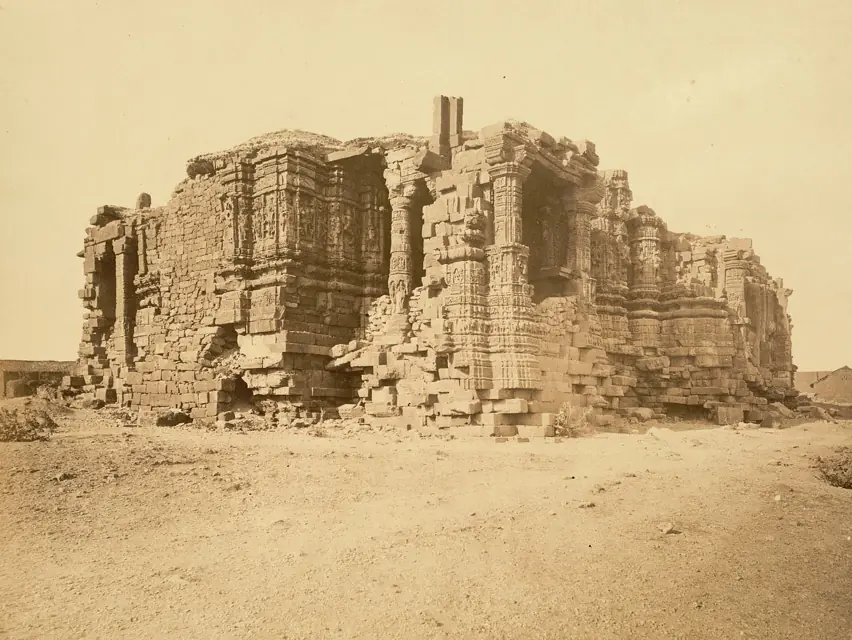
The town was stormed, the defenders slaughtered and the jyotirlinga broken.
01The assault
Mahmud left Ghazni in October 1025, passed Multan, crossed the desert and took Anhilwara, the Chaulukya capital, whose king Bhima I withdrew. In January 1026 he reached Somnath on the shore at Prabhas. Ibn al-Athir describes the townspeople watching from the walls, sure that Somnath would destroy the invaders; then the assault, the defenders going into the temple to pray and coming out to fight until they were killed, and more than fifty thousand dead. Al-Biruni, who served at Mahmud’s court, records that the upper part of the linga was broken and pieces were taken to Ghazni.
02Rebuilt every time
Bhima I and the Paramara king Bhoja are credited with rebuilding the temple soon after, and Kumarapala raised a new one in stone in 1169. Alauddin Khalji’s army struck it in 1299, Zafar Khan and the Gujarat sultans later, and Aurangzeb ordered it destroyed in 1665 and again in 1706. Ahilyabai Holkar built a new temple beside the ruins in 1783. After Independence Sardar Patel took up the rebuilding, and President Rajendra Prasad installed the jyotirlinga in the present temple on 11 May 1951.
Somnath became the symbol of the long resistance: broken by Mahmud and his successors, raised again each time by Hindu hands.