
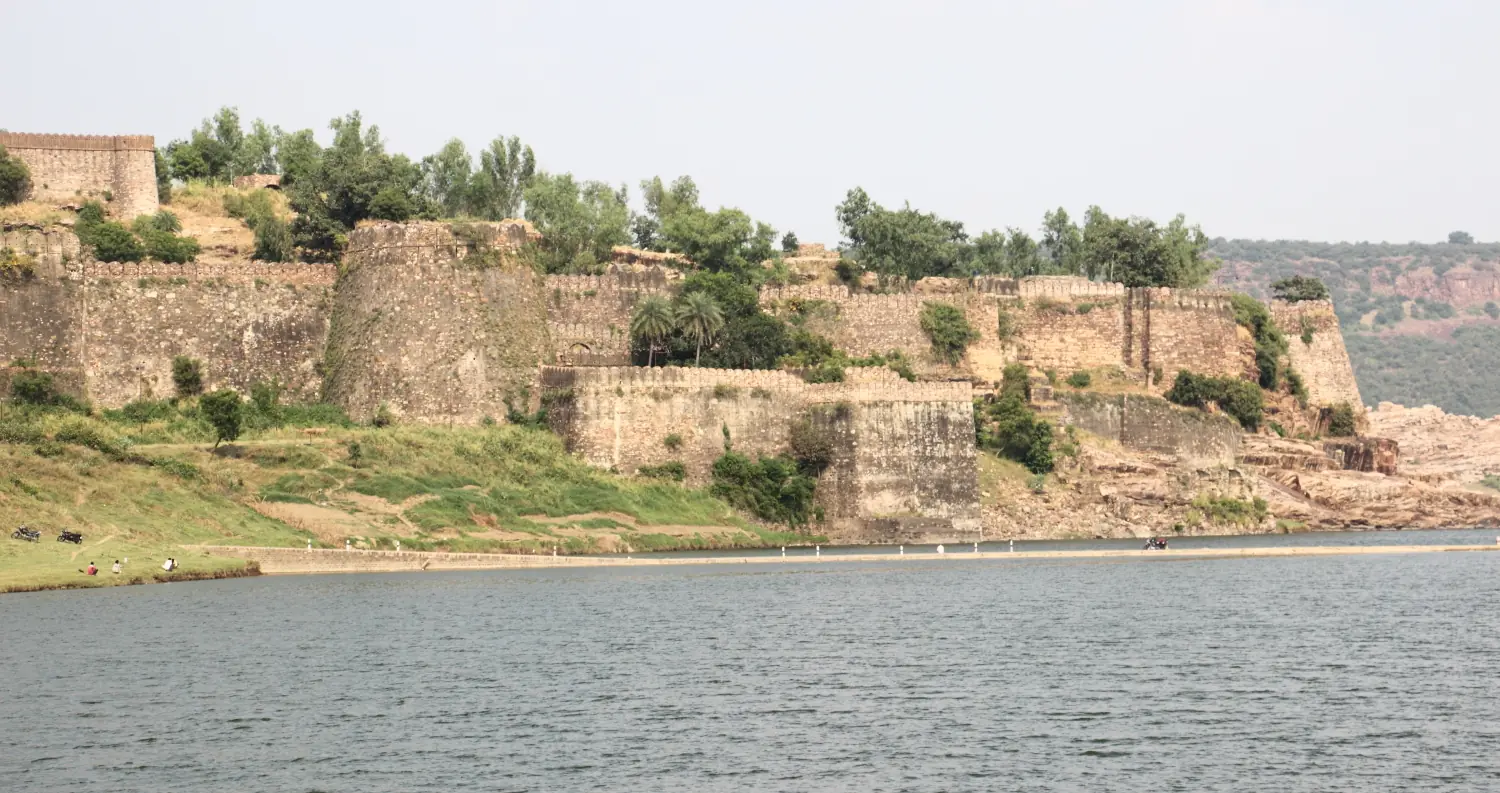
The fort fell; Achaldas died fighting, and the women of the fort performed jauhar.
01The water fort
Gagron rises straight out of rock where the Ahu river joins the Kali Sindh, with water on three sides and a moat on the fourth. It belonged to the Khichi branch of the Chauhans. Hoshang Shah, the Sultan of Malwa who built the walls of Mandu, came against it in 1423 with a large army and siege engines. Achaldas Khichi had no hope of relief. When the walls could no longer be held, the women of the fort performed jauhar, and Achaldas and his men opened the gates and died fighting.
02The Vachanika
The siege is the subject of one of the oldest works of Rajasthani literature, the Achaldas Khichi ri Vachanika of the charan poet Shivdas Gadan, written in the fifteenth century in mixed verse and prose. It tells the siege and the last stand in a high, ringing style. The Khichis were back in Gagron by the 1440s, and it was besieged again and taken by Mahmud Khalji of Malwa in 1444. Gagron is one of the six hill forts of Rajasthan inscribed together as a UNESCO World Heritage Site in 2013.
Gagron is one of the best documented Rajput last stands of the Sultanate age, recorded in a near-contemporary Rajasthani work.