
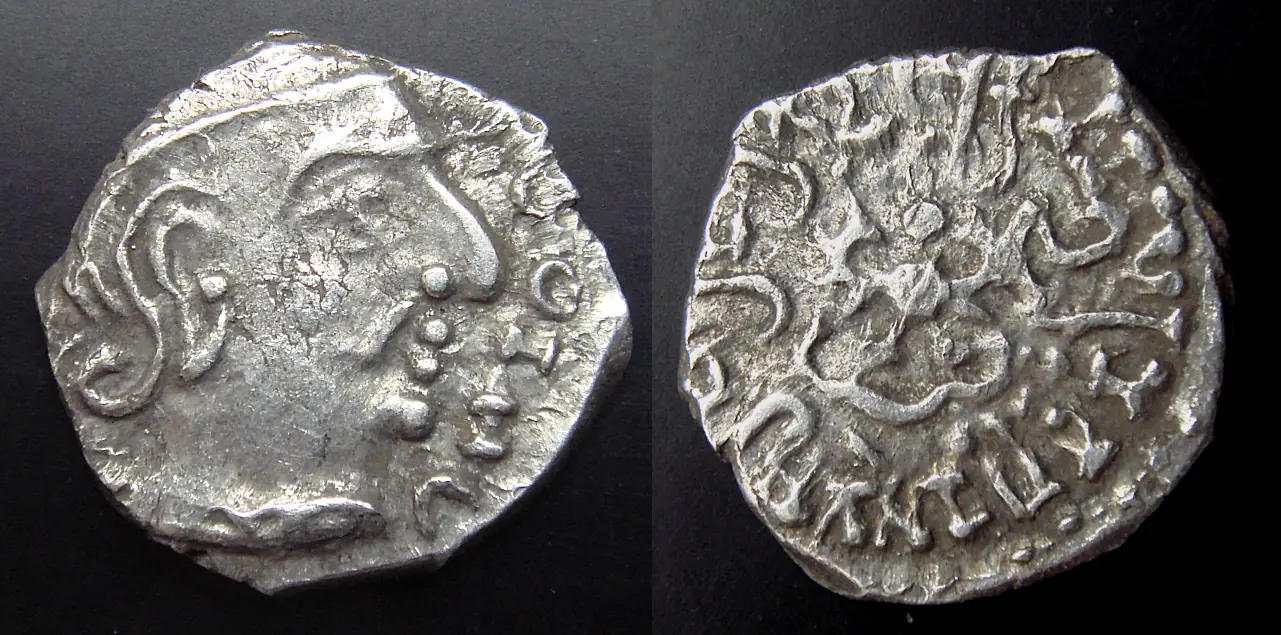
The Shaka rule of three centuries in Malwa, Gujarat and Saurashtra ended, and the Gupta empire reached the western sea.
01What the stones and coins say
No chronicle of the war survives. At Udayagiri near Vidisha, a minister named Virasena, also called Shaba, carved a note in a cave saying he had come there with the king, who was set on conquering the whole earth. The coins finish the account. The Western Kshatrapa silver series, dated year by year in the Shaka era, stops with Rudrasimha III. Soon after, Chandragupta II strikes silver coins of the same weight and pattern for the western markets, with a Garuda where the Kshatrapas had a hill, and Gupta-era dates. A whole fiscal system changed hands.
02The play of Dhruvadevi
Vishakhadatta’s drama Devichandraguptam, known today only from passages quoted by later writers on poetics, tells a darker tale. Chandragupta’s elder brother Ramagupta, hard pressed by a Shaka king, agrees to hand over his queen Dhruvadevi. Chandragupta goes to the Shaka camp dressed as the queen and kills the king. Banabhatta in the seventh century alludes to the same deed: in the enemy’s city the Shaka lord was slain by Chandragupta in a woman’s dress. Dhruvadevi is attested in Gupta seals as Chandragupta’s queen. How much of the play is history cannot be fixed, but the Guptas’ war with the Shakas was clearly remembered as personal.
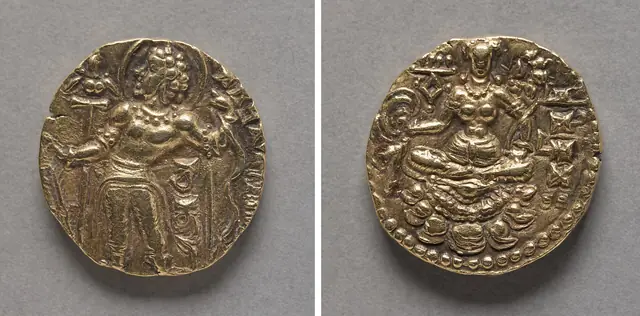
The conquest joined the Ganga plain to the Arabian Sea ports, making Ujjayini a second Gupta capital and the seat of the classical learning tradition remembers there.