
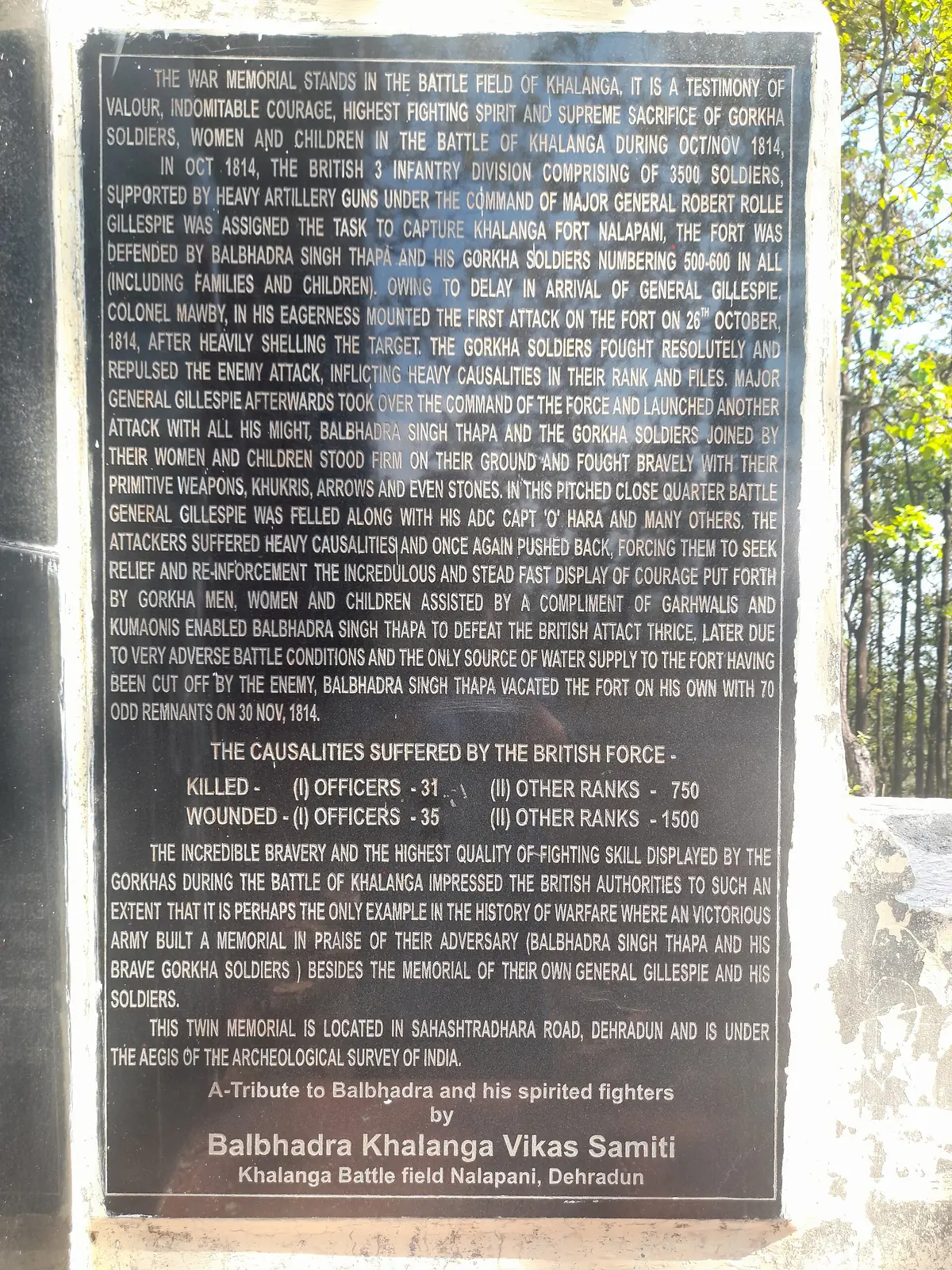
Two assaults failed and Gillespie was killed; with their water cut off, Balbhadra and the survivors broke out on 30 November.
01The fort on Nalapani
By 1814 the Gorkha kingdom of Nepal held the hills from the Teesta to the Sutlej, including Garhwal and Kumaon, and its border disputes with the Company in the plains led to war. One of the four Company columns, under Rollo Gillespie, marched into the Dun valley in October. On the Nalapani ridge Balbhadra Kunwar was building a small stone fort, Khalanga, with perhaps six hundred people inside, soldiers and their families. Gillespie stormed it on 31 October. The assault was beaten back, and Gillespie, leading from the front, was shot dead close to the wall.
02Thirst, and the break-out
The Company brought up heavy guns from Delhi and tried again on 27 November; the breach was too steep and the second assault failed with heavy loss. The garrison, though, had lost many dead, and the besiegers cut it off from its spring. James Baillie Fraser, who reached the fort soon after, describes the dead and wounded he found inside. On the night of 30 November Balbhadra led the seventy or so fighting men still on their feet out through the British lines and away into the hills. The Company razed Khalanga and set up two small obelisks below it, one for Gillespie and one for Balbhadra and his men.
Nalapani showed the Company what the Gorkha soldier was worth; after the war it began recruiting Gorkhas, whose regiments serve in the Indian Army to this day.