
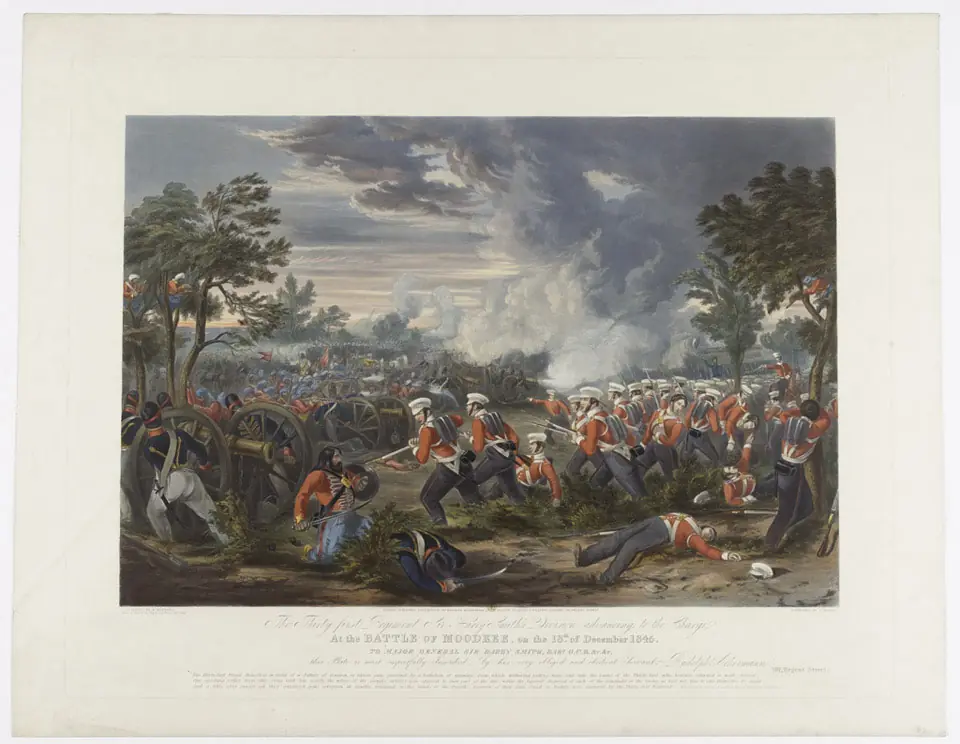
The Sikh advance force was pushed back after a fierce evening fight; the Company won the field but lost two generals.
01Across the Sutlej
After Ranjit Singh’s death in 1839 the Lahore Darbar fell into murder and faction, while the Khalsa army, the best-drilled Indian force of its day, grew powerful through its own regimental councils. The Company massed troops on the Sutlej. In December 1845 the Khalsa crossed the river. Its two commanders, the wazir Lal Singh and the commander-in-chief Tej Singh, were, as J. D. Cunningham later wrote from his own knowledge as a political officer, more anxious to see the army broken than to win. On 18 December Lal Singh led a force of cavalry and guns against the Company army as it reached Mudki after a long march.
02A battle in the dark
The fighting began late in the afternoon among scrub and sandhills, and went on after dark in clouds of dust, so that men fired at flashes. The Sikh gunners and infantry held their ground stubbornly, and the British would later call it ‘Midnight Mudki’. Lal Singh rode off early in the fight, and the Sikh line fell back under the weight of the Company’s numbers, leaving seventeen guns. Gough’s despatch lists 215 killed and 657 wounded on his side; among the dead were Sir Robert Sale and Sir John McCaskill. Three days later came Ferozeshah.
Mudki set the pattern of the war: brave Khalsa soldiers, Company numbers and guns, and commanders at Lahore who did not want their own army to win.