
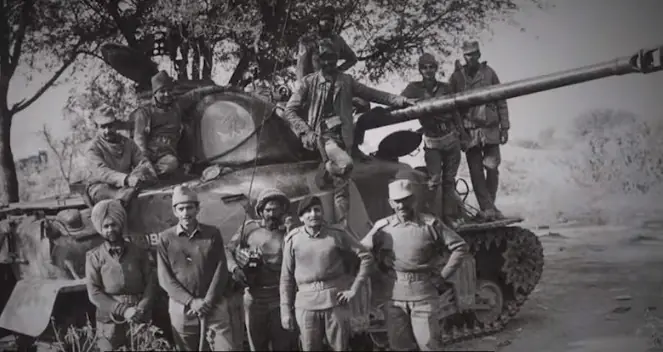
The Indian bridgehead over the Basantar held against repeated tank counter-attacks; dozens of Pakistani tanks were destroyed before the ceasefire.
01Through the minefields
While the main war was won in the east, India struck into the Shakargarh bulge, the Pakistani salient that pointed at the road from Pathankot to Jammu. In mid-December 1971, 47 Infantry Brigade of 54 Division seized a bridgehead across the Basantar river, a shallow stream covered by deep minefields. Engineers worked through the night of 15–16 December to clear lanes, and the tanks of 16 Armoured Brigade, among them the 17th Poona Horse, crossed before dawn to support the infantry. Pakistani armour counter-attacked at first light.
02Khetarpal and Hoshiar Singh
On 16 December Second Lieutenant Arun Khetarpal of the Poona Horse, twenty-one years old and six months commissioned, fought his Centurion tank at Jarpal against waves of Pakistani Pattons. His Param Vir Chakra citation records that he destroyed several enemy tanks and, when his own was hit and set on fire, refused to abandon it, fighting on until a second hit killed him. Nearby Major Hoshiar Singh of 3 Grenadiers, wounded, held Jarpal against counter-attack after counter-attack over two days and also won the Param Vir Chakra. The ceasefire came on the evening of 17 December with the bridgehead firm.
Basantar shut the Shakargarh threat to Jammu and remains one of the Indian Army’s proudest armoured actions; the Poona Horse still honours it as Basantar Day.