
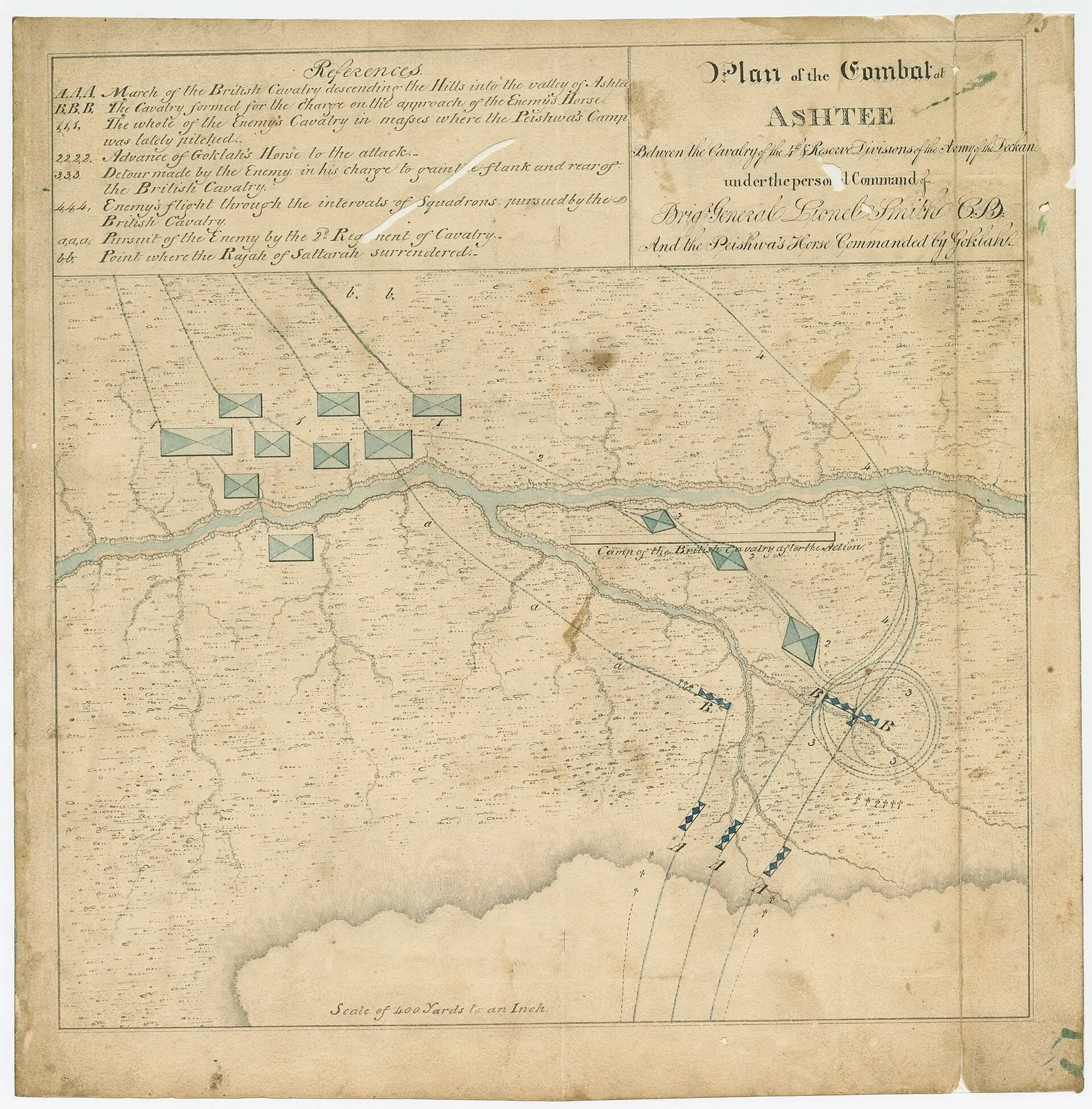
Bapu Gokhale was killed leading a charge, the Peshwa fled, and Chhatrapati Pratapsinh of Satara passed into Company hands.
01The long flight
After losing Pune, Bajirao II moved fast through the Deccan with his army, taking with him Pratapsinh, the young Chhatrapati of Satara, whom the Peshwas kept in their charge. Company columns hunted him for three months. On 1 January 1818 part of his army attacked a small Company force at Koregaon on the Bhima without breaking it. In February Brigadier-General Lionel Smith, with cavalry and horse artillery, at last came up with the Peshwa’s camp near Ashti, in the open country of the Solapur plain.
02Gokhale’s last charge
On 20 February 1818, as the Company horse came on, the Peshwa mounted and rode away. Bapu Gokhale, who had served the Peshwas all his life, gathered what cavalry he could and charged to hold the enemy back. Grant Duff writes that he fell fighting at the head of his men. The Maratha camp was taken, and with it Pratapsinh and his family, who were glad to be free of the Peshwa’s keeping. In April the Company restored Pratapsinh to a small kingdom at Satara, and in June 1818 Bajirao surrendered to John Malcolm and was sent on a pension to Bithur, near Kanpur.
Ashti was the last stand of the Peshwa’s army; with Gokhale dead and the Chhatrapati in Company hands, the Maratha confederacy that had ruled much of India for a century came to an end.