
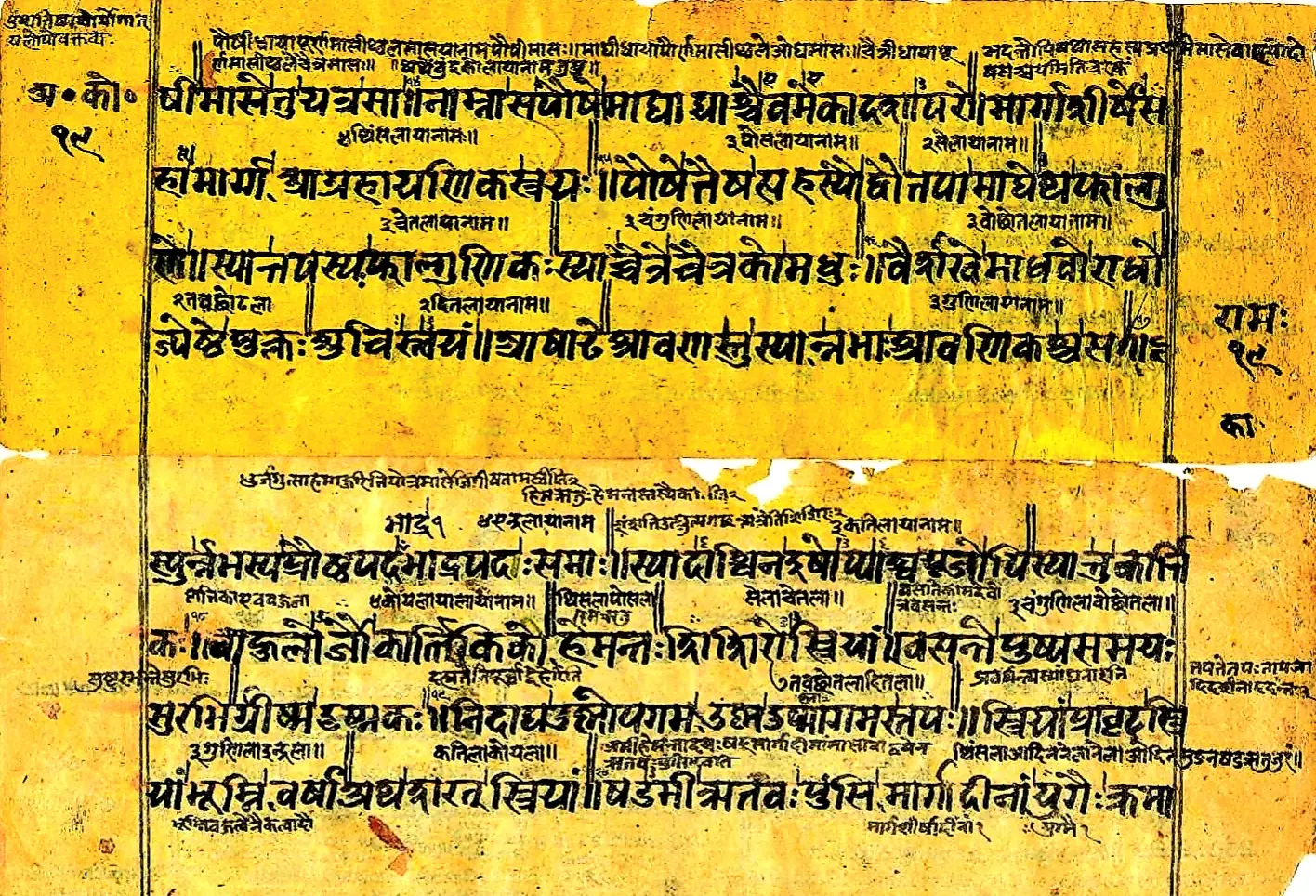
01A dictionary in verse
The full name says what it does: the teaching of nouns and their genders. Words are grouped by subject in three kandas, the first on heaven, the devas, time, sound and the mind, the second on earth, cities, mountains, plants, animals and the four varnas, the third on adjectives, homonyms and indeclinables. Synonyms are strung into anushtubh verses, so that ‘Agni’ comes with his many names in a single line that a child can chant. In the old system of learning, a boy in a Sanskrit school memorised the Amarakosha before he read the kavyas.
02One of the nine gems
A well-known verse lists the nine gems of Vikramaditya’s court: Dhanvantari, Kshapanaka, Amarasimha, Shanku, Vetalabhatta, Ghatakarpara, Kalidasa, Varahamihira and Vararuchi. Amarasimha stands third. His opening verse, praising a being who is an ocean of knowledge and compassion, has led many to count him a Buddhist; the work itself serves every Dharmic tradition, and Hindu, Jain and Buddhist scholars all wrote commentaries on it. Kshirasvamin’s commentary of the 11th century is among the oldest, and the Amarakosha travelled with Sanskrit learning to Tibet, Nepal and Sri Lanka.